How the Star Tribune Turned Republican “Somali Gangs” Rhetoric Into an Election-Year Crime Narrative
From zero mentions to 56: How Star Tribune reporting gave Republican rhetoric and police allegations the authority of news—turning “Somali gangs” into a recurring frame for crime coverage and amplifying an election-year campaign for expanded local, state, and federal enforcement.
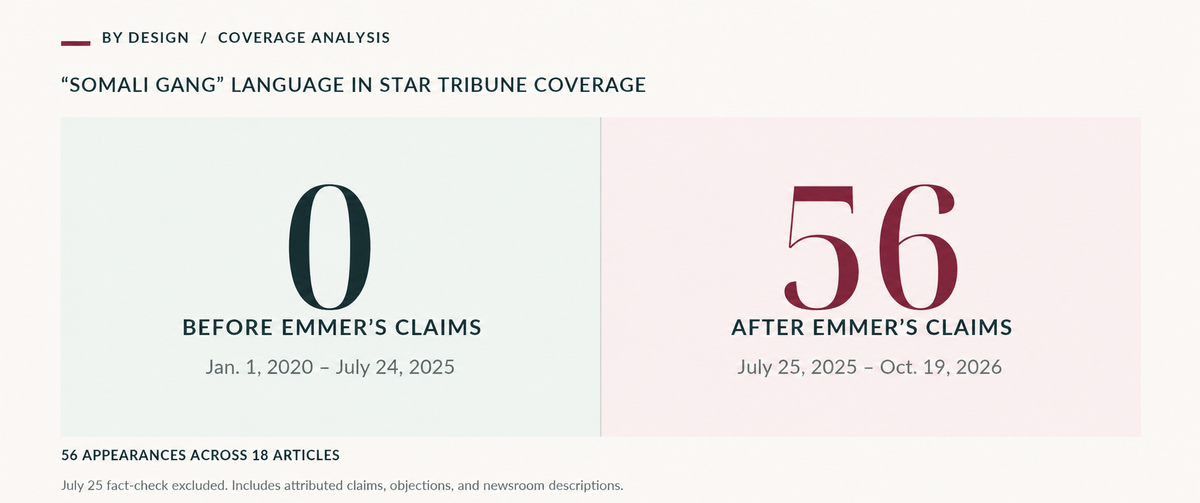
Before Rep. Tom Emmer accused Minnesota journalists of ignoring the threat of “Somali gangs” in July 2025, the phrase had appeared zero times in Star Tribune crime coverage dating back to January 2020. Since then, it has appeared 56 times. A By Design investigation traces how Star Tribune reporting gave Republican rhetoric and police allegations the authority of news—turning “Somali gangs” into a recurring frame for crime coverage and amplifying an election-year campaign for expanded local, state, and federal enforcement targeting Somali Minnesotans.
On October 7, 2026, federal prosecutors charged 18-year-old Minnesota resident Sheikhdoon Abdullahi Mohamud with receiving a firearm and ammunition to commit a federal crime of terrorism. The government alleged that he planned a mass shooting at the Mall of America. The charges had not been proven in court.
The Justice Department's press release made no allegation of gang involvement. At the accompanying news conference, U.S. Attorney Daniel Rosen said investigators were unaware of any gang affiliation. MPR News also reported Rosen's statement that Mohamud acted alone and "was not gang affiliated."
Yet the Star Tribune placed the unrelated terrorism case within a broader narrative of alleged “Somali gang violence”—both in the article itself and through the stories it labeled “Related” on its homepage.

“The terrorism charges come amid renewed concerns over gang violence in the Twin Cities between rival factions in the Somali community.”
U.S. Attorney Daniel Rosen said Mohamud acted alone and was not gang-affiliated.
Read the Star Tribune article ↗The Star Tribune did not allege that Mohamud belonged to a gang. It did not have to. The newspaper made the connection itself, using Somali ethnicity as the link between an unrelated terrorism case and the new media narrative of "Somali gang violence," and connecting the story to law enforcement calling for a regional task force to address gang violence.
Just days after a shooting in which the Star Tribune invoked "Somali gangs" in headlines, the racialized political narrative was already functioning as a self-reinforcing frame for crime coverage. Once ethnicity became the organizing frame, even incidents with no established connection could be folded into an expanding narrative of collective criminality, each new story appearing to confirm the last.
In the weeks before the election, Trump and Minnesota Republicans were escalating their targeting and racial scapegoating of Somali Minnesotans using allegations of gang violence and fraud, along with attacks on Somali Minnesotans’ immigration status, to portray an entire community as a criminal threat and demand mass arrests and expanded state, local, and federal enforcement.
The political amnesia was striking. Minnesota newsrooms had just spent months documenting the harms of a targeted federal crackdown justified through claims of immigrant criminality. Yet as police and Republican leaders advanced that same narrative ahead of the midterm elections, the Star Tribune was lending it the credibility and reach of its own headlines and reporting.
From Zero to 56 Mentions in 15 Months
Fifteen months earlier, on July 17, 2025, Rep. Tom Emmer, the U.S. House Majority Whip from Minnesota, appeared on Fox Business News with a warning: “These Somali gangs are incredibly dangerous.”
He accused Minnesota journalists of failing to report what he claimed was an ongoing threat from “Somali gangs.”
Emmer was right about one thing that day. Minnesota media hadn't been using his racialized crime framing in news coverage. A search of Star Tribune archives found no appearances of “Somali gang” or related wording in news and crime coverage from January 1, 2020, through Emmer's appearance on Fox Business News that day.
Eight days later, the Star Tribune challenged the claims Emmer made on Fox.
In its fact-check, the Star Tribune placed “Somali gangs” in quotation marks, examined court records that did not establish the alleged gang connections, and and reported Somali community leaders’ criticism that his remarks were racist, Islamophobic, and scapegoated their community.
A little more than a year later, the Star Tribune would use that same framing in its headlines. In the first 19 days of October 2026 alone, “Somali gang” and related language appeared 28 times in the newspaper’s coverage.
What Fletcher Gave Newsrooms—and What It Actually Showed
Police already held considerable authority to explain crime in the Star Tribune. A By Design analysis found police supplied the central narrative in 71% of the 65 Star Tribune stories between January 2020 and October 2026. (See analysis below.)
That pattern became especially consequential when Ramsey County Sheriff Bob Fletcher supplied newsrooms with a list of incidents spanning more than three years, presenting them as evidence of a growing, interconnected “Somali gang” threat spreading across the Twin Cities.
On July 6, 2026, Fletcher used his Live on Patrol livestream to claim that 14 homicides and more than 100 shootings involving Somali Minnesotans over the previous two years were “all gang-related.” Fletcher and sheriff’s investigators also described approximately 12 Somali gangs involving an estimated "300 young people."
To support his claims, Fletcher supplied newsrooms with a nine-page document titled East African Violence Timeline.
On July 10, the Star Tribune described Fletcher's document as a list of “more than 100 criminal cases” that were “believed to be connected to these gangs.” The Star Tribune would continue to cite the document in subsequent reporting from July through October as evidence of police claims.
But Fletcher’s document was neither a list of 100-plus criminal cases nor evidence that those incidents were connected to gangs
A By Design review found 104 incident summaries, including encounters that identified no crime, arrest, or charge.
Only 45 of the 104 even mentioned gangs or claimed gang associations. The other 59 made no gang reference at all. And even when the document labeled someone as gang-affiliated, it generally provided no evidence to substantiate that connection.
Fletcher's list mixed homicides and shootings with traffic stops, warrant arrests, fights, citations, and trespass notices.
A May 2026 entry described 30 juveniles fighting at a Woodbury Whole Foods, without identifying a gang connection, arrest, or charge.
A March 2025 entry described an individual “found in videos with firearms,” then labeled him affiliated with the Ville gang. It identified no alleged crime or evidence explaining the classification.
Another entry described a juvenile assaulted with a bat at a Minneapolis YMCA and claimed the victim's family "had ties" to Muddy, without explaining the alleged association or its relevance to the assault.
Fletcher's list linked a toddler to a "known muddy affiliate"
One of the most revealing entries concerned the May 19, 2024, shooting that killed Lilian Poalacin Perez and wounded her two-year-old son.
Fletcher's document incorrectly dated the shooting as September 19 and stated that the toddler was going to see a “known muddy affiliate.”
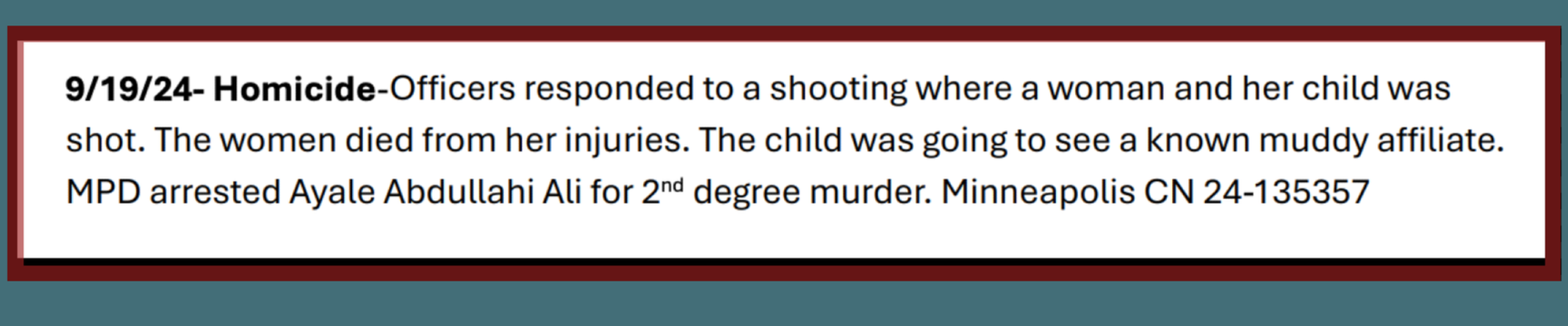
The criminal complaint described a mother holding her toddler in the back seat of her family's car while his father stopped to borrow tools from his brother. A gunman approached and fired into the vehicle.
The complaint identified no gang affiliation involving the family and offered no gang-related explanation for the shooting. The man responsible later pleaded guilty to murder and assault and was sentenced to 37½ years in prison.
What the list could not establish
Fletcher presented the document as evidence for claims it did not substantiate: an estimated 300 gang members, more than 100 gang-related shootings, and an “exponential” increase in violence.
It provided no documentation supporting the membership estimate, no verified accounting of those shootings, and no comparable counts demonstrating that increase.
The existence of particular gangs did not establish connections between separate crimes or validate Fletcher’s claims of a growing threat across the Twin Cities.
An August court ruling illustrated that distinction.
A Ramsey County judge found that a group known as Muddy met Minnesota's statutory definition of a criminal gang and found that three named people belonged to it for purposes of a civil injunction restricting conduct around the State Fair. Seven other people agreed to stay away from the State Fair while denying gang membership.
Those findings concerned a specific organization and identified individuals. They did not validate Fletcher's broader claims about 300 young people or an expanding ethnic gang threat across the Twin Cities.
The judge also warned against using the ruling to justify scrutiny of the larger Somali community.
Yet Emmer was already using Fletcher's figures to demand federal intervention targeting Somali Minnesotans
On July 23, Emmer and Minnesota's Republican congressional delegation called on U.S. Attorney Daniel Rosen to “stamp out Somali gang violence.”
The accompanying press release repeated Fletcher's claims of 300 gang members, 14 murders, and more than 100 shootings. It went further, asserting that Somali residents made up roughly 2% of the Twin Cities population but at least 13% of its gang population—turning Fletcher's unsubstantiated figures into a claim about criminality within an entire ethnic community.
Emmer then linked the alleged gang violence to his claims of "billions in fraud," declaring: "If you won’t assimilate, then get the hell out of here."
Fletcher's figures had now become part of a congressional demand for federal enforcement. The press release presented Somali ethnicity itself as a measure of criminal threat, accompanied by an explicit message that Somali Minnesotans who failed to "assimilate" did not belong.
*Method: All 104 main summaries were reviewed. Checks against underlying criminal records were targeted, not exhaustive.
By October, the Star Tribune Was Framing Crime Through Emmer and Fletcher’s Claims
On October 3, hours after a shooting wounded two Somali teenagers outside Eden Prairie High School's homecoming football game, Rep. Tom Emmer declared on social media that it was “another Somali gang crime.”
He again challenged Minnesota journalists to tell the public what he called the truth, accusing them of political correctness and warning that Somali gangs were endangering “our communities” and “our children.”
The racialized message was unmistakable: the two teenagers wounded were Somali, yet Emmer invoked “our communities” and “our children” as those needing protection from “Somali gangs.” Somali Minnesotans were the victims of the shooting, but in his telling, they were the threat.
That evening, the Star Tribune incorporated his accusation into its reporting.
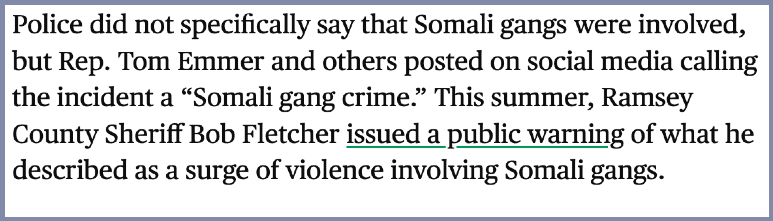
The story acknowledged that police had not identified a specific gang as responsible for the shooting. Yet it included Emmer’s racially charged social media post alongside Fletcher’s earlier claims, placing the shooting within the broader ethnic crime narrative both officials were promoting.
The Star Tribune had already challenged the evidence behind Emmer’s earlier gang allegations. Now it was giving his latest rhetoric the authority of news context, without scrutinizing its role in his broader political campaign targeting Somali Minnesotans.
Three days later, the Star Tribune published its own headline: “Eden Prairie shooting renews concern over Twin Cities Somali gang violence.”
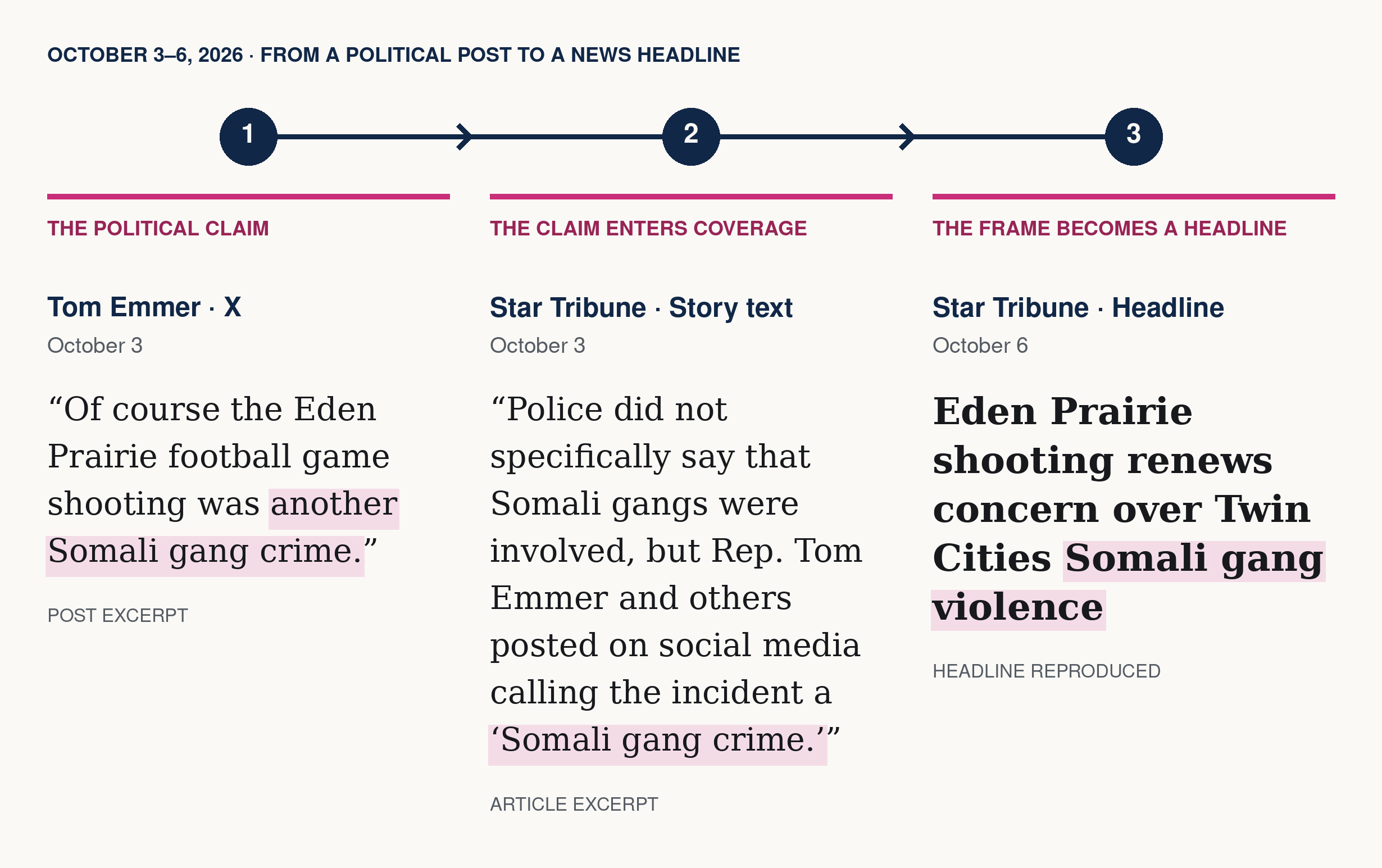
Police supplied the explanation. The Star Tribune chose the frame.
For this investigation, By Design reviewed 126 selected Star Tribune articles published between January 2020 and October 9, 2026, examining whose accounts defined events and whether other substantive explanations appeared.
Among 65 stories about incidents, investigations, arrests, and new criminal charges, police-origin accounts supplied the central explanation in 46 stories (71%). In 33 (51%), there was no separately sourced substantive account beyond the police version.
The findings do not establish why individual editors made their decisions. They show that police already held substantial authority to explain crime in the selected coverage before Fletcher began promoting an expanding “Somali gang” threat.
But it was the Star Tribune that decided how those police accounts would become news.
Journalistic standards have long cautioned against identifying people by race or ethnicity without establishing why that information matters. The Associated Press Stylebook warns against unnecessary racial and ethnic identification.
As journalist Keith Woods explained for Poynter, vague racial descriptions can cast suspicion over entire communities while telling readers little about the people involved. The AP's guidance on reporting propaganda also cautions journalists against lending credibility to political claims simply by repeating them.
A gang is not an ethnicity. A shooting involving Somali young people does not make Somali identity an explanation for gun violence.
Identifying a criminal gang requires identifying the organization, its conduct, and the people allegedly connected to it. Calling separate incidents “Somali gang violence” instead makes a shared ethnic identity the connection, instead of the alleged crimes or gang affiliation itself.
That raised a more fundamental question for the Star Tribune: Why was Somali ethnicity being used to connect separate crimes in the first place?
If investigators claimed evidence of particular gangs and criminal networks, then the reporting should have been able to identify those organizations, the people allegedly involved, their conduct, and the evidence connecting specific cases.
Emmer and Fletcher chose to define the alleged threat through Somali ethnicity. The Star Tribune carried that racial coding into its own crime reporting, using “Somali gang violence” as shorthand for connections between crime its own reporting had not established.
The language was spreading beyond the Star Tribune, too. A supplementary search of KARE, KSTP, and WCCO coverage identified 37 articles across all three outlets using “Somali gangs” or related wording between January 2020 and October 13, 2026. All but one appeared after Emmer's July 2025 challenge to Minnesota journalists.
By contrast, MPR’s October coverage used “Somali gangs” only in quotation marks, treating it as a contested political narrative rather than an established crime category.
Its reporting centered Somali Minnesotans’ experiences and challenged the ethnic framing. In one story, Metro State University professor and gang expert James Densley called the label “a totally made-up word,” adding, “I just don't buy the idea that you would preface any group by its ethnicity first.”
Star Tribune coverage analysis
How Police Accounts Shaped Star Tribune Crime Reporting
The review classified 126 selected Star Tribune articles by reporting task, whose account chiefly explained events, whether substantive alternatives appeared, and what evidence supported an organizing claim. In stories about specific incidents and new charges, the police-origin account often supplied the central explanation—even when other voices appeared elsewhere in the story.
Police supplied the central explanation
46 of 65 incident/charging stories
No separate substantive account beyond the police version
33 of the same 65 stories
The measures overlap: 31 of the 65 met both criteria. In two stories the police-only classification was unclear. These are stories, not unique incidents or a random sample of the newspaper’s reporting.
Across all 126 selected articles—including court proceedings, data analyses, community responses and policy stories—police supplied the primary explanation in 55 (44%) and the only substantive incident or explanatory account in 34 (27%). Different kinds of stories had different sources and reporting tasks; the 71% and 51% figures apply only to the 65 incident/charging stories.
Examine the 65 stories and the coding decisions
The table lists each selected incident/charging story with its original article link. “Police primary” means the police-origin explanation chiefly organized the account; “only police” means no separately sourced substantive incident or explanatory account appeared. Each story’s notes identify the judgment and, when assessed, the support and limits of a selected claim.
| Article | Primary explanation from police? | Only substantive account from police? | What the coding found |
|---|---|---|---|
| Jan. 22, 2020Person of interest developed in Spring Lake Park shooting that left 1 dead, 7 wounded | Yes | Yes | Read coding noteCoding reason: Affiliation and person-of-interest reconstruction come from investigator affidavit; role in shooting expressly unresolved. Selected claim: Gang-related shooting; video identifies a person of interest. Reported basis: Partial / indirect basis for the selected inference Affidavit: altercation video, sweatshirt lettering and unspecified intelligence. Additional comparison: Separate comparison of selected core inference not shown Jail history and uncertainty reported; no separate gang-classification test. Limit: Clothing and presence do not establish a role in firing shots. |
| Mar. 28, 2020Driver hit Edina student boarding bus to prove he could kill, charges say | Yes | Yes | Read coding noteCoding reason: Police-mediated passenger accounts supply motive; mother describes impact. Selected claim: Driver deliberately struck a student to demonstrate willingness to kill. Reported basis: Specific allegation-level basis reported Complaint: two passengers' police interviews; vehicle damage. Additional comparison: Separate comparison of selected core inference not shown Mother discusses consequences, not driver's intent. Limit: Reported motive comes from passengers through police. |
| Mar. 31, 2020Altercation at birthday party preceded fatal Minneapolis shooting, charges say | Yes | Yes | Read coding noteCoding reason: Witness and surveillance account reaches story through charges. Selected claim: Birthday-party confrontation led the accused to fire at attendees. Reported basis: Specific allegation-level basis reported Charges: witnesses, vehicle surveillance and driver interview. Additional comparison: Separate comparison of selected core inference not shown Missing motive and relationships acknowledged. Limit: Charging reconstruction remains an allegation. |
| Apr. 12, 2020Charge: Same burglar responsible for 2 recent Twin Cities gun shop break-ins | Yes | Yes | Read coding noteCoding reason: Officer's clothing, shoe and property matches connect burglaries. Selected claim: Two gun-shop burglaries share a suspect. Reported basis: Specific allegation-level basis reported Complaint: clothing, shoe tread, stolen-gun tag and videos. Additional comparison: Separate comparison of selected core inference not shown No separate comparison outside investigative account shown. Limit: Reported matches support an alleged link, not adjudication. |
| May. 9, 2020Alleged serial rapist now charged in 9 cases in Minneapolis, Anoka County | Yes | Yes | Read coding noteCoding reason: Police DNA and witness reconstruction links alleged attacks; prior newspaper investigation adds background. Selected claim: A suspect connects multiple stalking and sexual-assault cases. Reported basis: Specific allegation-level basis reported Complaints and police: DNA, recovered identification and witness accounts. Additional comparison: Additional reporting addresses context or a different proposition Prior newspaper investigation adds context; new case links remain investigative. Limit: Underlying DNA and full case files not independently authenticated here. |
| Jun. 22, 2020'Tragic and senseless' late-night gunfire in Minneapolis kills 1, wounds 11 | NoShared explanations | No | Read coding noteCoding reason: Police lead; witnesses, observed aftermath and correction supply additional accounts. Note: This entry records the authority classification, not a uniform claim-by-claim evidence audit. |
| Aug. 14, 2020Three charged in Minneapolis slaying of rival gang member | Yes | Yes | Read coding noteCoding reason: Charging narrative explicitly traces police investigation and witnesses. Selected claim: Three accused men participated in a fatal shooting. Reported basis: Specific allegation-level basis reported Charges: witnesses describing vehicles, gunfire and participants. Additional comparison: Separate comparison of selected core inference not shown No separately obtained witness account shown. Limit: Gang classifications require their own evidentiary assessment. |
| Sep. 7, 2020Back-to-back Labor Day carjackings in Minneapolis may be linked | Yes | No | Read coding noteCoding reason: Victim opens account; police propose cross-incident link without demonstrating it. Selected claim: Back-to-back carjackings may share the same offenders. Reported basis: Partial / indirect basis for the selected inference Similar methods and police belief; victim account of one attack. Additional comparison: Independent event/component account; core inference not tested Victim independently recounts one event, not the link between both. Limit: No disclosed identification or evidence matching offenders across attacks. |
| Sep. 29, 2020Suspects in Edina hospital parking ramp shooting that injured doctor charged with multiple felonies | Yes | Yes | Read coding noteCoding reason: Investigative video and phone reconstruction presented through complaint. Selected claim: The accused committed a hospital-parking-ramp shooting and robbery. Reported basis: Specific allegation-level basis reported Complaint: video, vehicle trace, phone data and recovered clothing. Additional comparison: Additional reporting addresses context or a different proposition Conviction history adds context, not a separate test of this shooting. Limit: Police interpretation of digital evidence remains record-mediated. |
| Nov. 18, 2020Teens arrested in gang shooting that injured bystander, nearly struck 4-year-old | Yes | Yes | Read coding noteCoding reason: Police and complaint supply gang and gunfight reconstruction. Selected claim: The accused participated in an exchange of gunfire outside a market. Reported basis: Specific allegation-level basis reported Complaint: surveillance, witness accounts, vehicle and weapon evidence. Additional comparison: Separate comparison of selected core inference not shown Defendant's recorded denial appears through police material. Limit: Gunfight reconstruction does not itself prove gang affiliation. |
| Dec. 24, 2020St. Paul police investigating after 2-year-old killed by gunfire | NoNo explanation beyond basic facts | Yes | Read coding noteCoding reason: Basic fatality account leaves circumstances unknown; community response does not reconstruct shooting. Note: This entry records the authority classification, not a uniform claim-by-claim evidence audit. |
| Jan. 15, 2021Suspect shot after gunfire exchange with police in north Minneapolis | Yes | No | Read coding noteCoding reason: Eyewitness and bystander video compare with police sequence. Selected claim: A suspect exchanged gunfire with responding police. Reported basis: Specific allegation-level basis reported Police account, dispatch audio, independent eyewitness and bystander video. Additional comparison: Separate material directly addresses a core sequence Witness describes who fired first; video and audio bear on sequence. Limit: Partial sequence support does not resolve every use-of-force question. |
| May. 2, 2021Seven injured in three St. Paul shootings; 'It sounded like a war zone' | Yes | No | Read coding noteCoding reason: Police reconstruct shootings; neighbor supplies aftermath and mayor offers broader cause. Selected claim: Police reconstruct three shootings, including an exchange between two groups. Reported basis: Specific allegation-level basis reported Police-mediated victim accounts and scene observations. Additional comparison: Independent event/component account; core inference not tested Neighbor independently describes gunfire and aftermath at one location. Limit: Neighbor does not identify all participants or establish initiation. |
| May. 15, 202170 casings, many scars, no answers almost a year after Uptown Minneapolis mass shooting | NoNewspaper analysis / reconstruction | No | Read coding noteCoding reason: Survivors and newspaper scrutiny organize missing police answers; affidavit limits reported. Note: This entry records the authority classification, not a uniform claim-by-claim evidence audit. |
| May. 19, 2021Gunfire hits another child: Activist's granddaughter, 6, shot in head while in vehicle in north Minneapolis | NoShared explanations | No | Read coding noteCoding reason: Family experience and prevention criticism share organizing role with official incident context. Note: This entry records the authority classification, not a uniform claim-by-claim evidence audit. |
| Jul. 13, 20212 couples charged in killing of man targeted for burglary in his southern Dakota County home | Yes | Yes | Read coding noteCoding reason: Suspect statements to investigators and physical evidence supply account. Selected claim: Four accused people acted together in a robbery and killing. Reported basis: Specific allegation-level basis reported Complaints: accused statements, communications, physical and medical findings. Additional comparison: Separate comparison of selected core inference not shown No separately obtained account tests the alleged joint conduct. Limit: Medical findings reach reader through complaints. |
| Aug. 6, 2021Charges: Rift over gun led to fatal shooting outside Minneapolis funeral | Yes | Yes | Read coding noteCoding reason: Witness accounts through charges supply motive and gang association. Selected claim: A dispute over a gun led one friend to kill another. Reported basis: Specific allegation-level basis reported Charges: funeral witnesses describe argument and shooting. Additional comparison: Separate comparison of selected core inference not shown No separately obtained account of motive or shooting shown. Limit: Same-gang characterization is a separate proposition. |
| Sep. 8, 2021Boy, 12, fatally shot during dispute on Minneapolis' North Side | Yes | No | Read coding noteCoding reason: Police supply dispute explanation; neighbor describes response and wider concerns. Selected claim: A neighborhood dispute culminated in a boy shooting a 12-year-old. Reported basis: Partial / indirect basis for the selected inference Police spokesman reconstructs argument; witness description is relayed by police. Additional comparison: Independent event/component account; core inference not tested Neighbor describes hearing shots and responding afterward. Limit: Independent response account does not establish dispute or shooter's identity. |
| Dec. 17, 2021Two teens arrested in connection with St. Louis Park, Edina carjackings | Yes | Yes | Read coding noteCoding reason: Police link suburban attacks; prosecutors and mayors respond without independent incident account. Selected claim: The same teen suspects connect two suburban attempted carjackings. Reported basis: Partial / indirect basis for the selected inference Police linkage and release of surveillance images. Additional comparison: Separate comparison of selected core inference not shown Other officials discuss enforcement rather than independently establish the link. Limit: Method matching suspects across both incidents is not explained. |
| Jan. 6, 2022Gunman knew the victim he shot at Mall of America, charges say | Yes | Yes | Read coding noteCoding reason: Victim and accused accounts mediated by complaint; prosecutor announces action. Selected claim: A pursuit between acquaintances preceded the accused firing inside the mall. Reported basis: Specific allegation-level basis reported Complaint: victim and accused statements to police. Additional comparison: Separate comparison of selected core inference not shown Competing details are carried within the investigative account. Limit: No separate access to those accounts is shown. |
| Jan. 21, 20222 teens charged in alleged metrowide carjacking wave | Yes | Yes | Read coding noteCoding reason: Police admissions and vehicle chain in complaints supply multi-city link. Selected claim: Two accused people committed a multi-city series of carjackings. Reported basis: Specific allegation-level basis reported Complaints: reused vehicles, transactions and admissions. Additional comparison: Separate comparison of selected core inference not shown No outside reconstruction of the alleged series shown. Limit: Specific alleged links do not independently validate every charged act. |
| Feb. 5, 20227 Minneapolis men face federal charges for violent crimes | NoProsecutor primary | No | Read coding noteCoding reason: U.S. attorney organizes separate charges as enforcement response. Note: This entry records the authority classification, not a uniform claim-by-claim evidence audit. |
| Mar. 16, 2022Man stabbed ex-girlfriend at her St. Paul workplace, then set her on fire, charges say | Yes | No | Read coding noteCoding reason: Police case leads; father independently describes behavior and civil filing adds abuse history. Selected claim: The accused killed his former partner at her workplace. Reported basis: Specific allegation-level basis reported Complaint: coworkers, accused interview, medical and physical evidence. Additional comparison: Additional reporting addresses context or a different proposition Father interview and protection-order records substantiate context, not direct observation of killing. Limit: Prior-abuse documentation is distinct from checking responsibility for this killing. |
| Mar. 21, 20223 felons charged in fatal shooting of man whose funeral in St. Paul was scene of deadly gunfire | Yes | Yes | Read coding noteCoding reason: Officer court filing and police investigation connect killings and gang conflict. Selected claim: Investigation connects suspects, shootings and alleged conflict. Reported basis: Specific allegation-level basis reported Court filings: videos, vehicle traces and recovered weapon links. Additional comparison: Separate comparison of selected core inference not shown Prior conviction supplies background, not proof of current affiliation or motive. Limit: Physical links and gang classifications have different evidentiary reach. |
| Jul. 5, 2022Gunfire at Boom Island Park in Minneapolis wounds 7 people, leaving 'several in critical condition' | NoNo explanation beyond basic facts | No | Read coding noteCoding reason: Park Board spokespeople give initial facts; police agency attribution not explicit. Note: This entry records the authority classification, not a uniform claim-by-claim evidence audit. |
| Aug. 11, 2022Police: Suspects in last week's Mall of America shooting arrested in Chicago | Yes | Yes | Read coding noteCoding reason: Chief and charging surveillance narrative reconstruct mall shooting and flight. Selected claim: Two suspects were involved in mall gunfire and subsequent flight. Reported basis: Specific allegation-level basis reported Chief and charges: surveillance, cartridges, vehicle and shuttle account. Additional comparison: Separate comparison of selected core inference not shown No independently sourced comparison of participant roles shown. Limit: Article does not clearly state independent access to underlying video. |
| Dec. 30, 2022Four teens charged in fatal shooting at Mall of America during fight | Yes | Yes | Read coding noteCoding reason: Charges and chief reconstruct shooting; outside voices address harm and security. Selected claim: Named suspects fired during the fatal Nordstrom confrontation. Reported basis: Specific allegation-level basis reported Complaint: video sequence, weapon and casing evidence. Additional comparison: Separate comparison of selected core inference not shown Limits on firing sequence explicitly acknowledged. Limit: Acknowledging uncertainty is different from separately testing the reconstruction. |
| Mar. 22, 2023Boys charged with bringing gun to Golden Valley middle school | Yes | Yes | Read coding noteCoding reason: Chief supplies possession and delay account; district gives administrative response, with no separate incident reconstruction. Selected claim: Two boys possessed a gun in a school bathroom. Reported basis: Specific allegation-level basis reported Chief describes Snapchat video obtained through a warrant. Additional comparison: Additional reporting addresses context or a different proposition District response and meeting records address reporting policy, not independent verification of gun possession. Limit: The publication does not state that reporters independently authenticated the video. |
| Mar. 23, 2023Man charged with stabbing his wife to death in St. Paul during Bible study | Yes | Yes | Read coding noteCoding reason: Police-mediated family witnesses provide homicide reconstruction. Selected claim: The accused fatally stabbed his wife during a family gathering. Reported basis: Specific allegation-level basis reported Complaint: family witnesses, medical findings and accused interview. Additional comparison: Separate comparison of selected core inference not shown No separate event account outside investigative filing shown. Limit: Family quotations through police are not separate newspaper interviews. |
| May. 3, 2023Federal racketeering charges target Minneapolis Highs and Bloods gangs | NoProsecutor primary | No | Read coding noteCoding reason: Prosecutors supply RICO enterprise theory; defense challenges allegation standard. Note: This entry records the authority classification, not a uniform claim-by-claim evidence audit. |
| May. 15, 2023Girl, 15, dies from wounds sustained during north Minneapolis shootout | NoNo explanation beyond basic facts | No | Read coding noteCoding reason: Police incident reports supply event account; separately cited medical examiner report supplies fatal-injury evidence. Note: This entry records the authority classification, not a uniform claim-by-claim evidence audit. |
| May. 25, 2023Teen arrested over allegedly firing gun while police responded to a stabbing at Washburn High School | Yes | No | Read coding noteCoding reason: Chief reconstructs stabbing and gunfire; student supplies separate event account. Selected claim: A boy fired outside Washburn while police responded to a stabbing. Reported basis: Specific allegation-level basis reported Chief: officer observation, recovered gun and casings. Additional comparison: Independent event/component account; core inference not tested Student independently describes running people and hearing gunshots. Limit: Witness does not independently identify the accused as the shooter. |
| May. 30, 2023Teens charged in stabbing, shooting at Washburn High School | Yes | Yes | Read coding noteCoding reason: Police investigative account carried by juvenile petitions; school identifies attendance status. Selected claim: Two accused teens separately stabbed and fired during the school event. Reported basis: Specific allegation-level basis reported Juvenile petitions: video, photo, victim accounts and recovered weapons. Additional comparison: Separate comparison of selected core inference not shown School clarifies enrollment; suspect account disputes circumstances through police. Limit: Enrollment confirmation does not test responsibility for the violent acts. |
| May. 31, 2023'He was a king:' Grieving Minneapolis mother decries violence following son's Memorial Day slaying | NoCommunity / practitioner | No | Read coding noteCoding reason: Family and reviewed texts supply account; police remain secondary. Note: This entry records the authority classification, not a uniform claim-by-claim evidence audit. |
| Aug. 16, 2023Federal prosecutors charge 14 Minneapolis gang members in latest chapter of push to curb gun crimes | NoProsecutor primary | No | Read coding noteCoding reason: Prosecutorial gang-enforcement framework leads; attorney responds. Note: This entry records the authority classification, not a uniform claim-by-claim evidence audit. |
| Dec. 6, 2023Brawl inside Dinkytown tobacco shop led to shooting that killed 2, injured clerk | NoNewspaper analysis / reconstruction | No | Read coding noteCoding reason: Newspaper video review reconstructs event and corrects regulatory claim. Note: This entry records the authority classification, not a uniform claim-by-claim evidence audit. |
| Sep. 6, 2024Twin Cities teacher, already in prison, indicted in sexual assault of 12 more children | Yes | Yes | Read coding noteCoding reason: BCA identification of victims and video evidence supplies the abuse account via indictment announcement; civil litigation is separate background. Selected claim: Investigators connect twelve additional children to alleged recorded abuse. Reported basis: Specific allegation-level basis reported BCA investigation, recovered videos and indictment announcement. Additional comparison: Additional reporting addresses context or a different proposition Civil records document hiring litigation, not independent authentication of new abuse evidence. Limit: Video evidence and identifications are described, not independently authenticated here. |
| Oct. 9, 20246 kids arrested after armed robbery spree, 2 stolen vehicle crashes in Minneapolis | Yes | No | Read coding noteCoding reason: Police supply spree and youth-system explanation; victims challenge police follow-up. Selected claim: Six children participated in an armed robbery and stolen-vehicle sequence. Reported basis: Partial / indirect basis for the selected inference Police describe vehicle pursuit and arrests; owners account for stolen vehicles. Additional comparison: Independent event/component account; core inference not tested Owners independently account for stolen vehicles and recovery components. Limit: Those details support components of the sequence but do not disclose how each child's responsibility for the armed robberies was established. |
| Oct. 30, 202411 alleged Minneapolis Lows gang members indicted on racketeering charges that include 5 homicides | NoProsecutor primary | No | Read coding noteCoding reason: Prosecutor's racketeering enterprise theory organizes indictment story. Note: This entry records the authority classification, not a uniform claim-by-claim evidence audit. |
| Nov. 18, 2024St. Paul shooting victim dies shortly after city leaders’ plea to public to end gun violence | Yes | No | Read coding noteCoding reason: Police chief supplies citywide gun-access and decision-making explanation; mayor and pastor support community response. Selected claim: Recent homicides span different circumstances but mostly involve firearms. Reported basis: Partial / indirect basis for the selected inference Chief's case categorization; newspaper database says eight of ten involved guns. Additional comparison: Newspaper tally addresses part of core account; source independence unestablished Database tally addresses common weapon, not the chief's broader behavioral explanation. Limit: The database's underlying source independence is not established by the article. |
| Jan. 31, 2025More teens charged in ambush during game of Fridley basketball player with tire iron and fists | Yes | Yes | Read coding noteCoding reason: Complaint and police reconstruct planned school assault; school clarifies enrollment. Selected claim: Five accused teenagers coordinated a school-game assault. Reported basis: Specific allegation-level basis reported Complaints: arrival video, attack sequence, injuries and arrests. Additional comparison: Separate comparison of selected core inference not shown School enrollment statements do not independently establish coordination or responsibility. Limit: The reason for the attack remains withheld. |
| Feb. 11, 2025Three boys, ages 11 to 15, charged in violent daylight carjacking in Minneapolis | Yes | Yes | Read coding noteCoding reason: Police supply carjacking narrative; juvenile petitions unavailable and prosecutor explains limits. Selected claim: Six juveniles participated in a carjacking and later pursuit. Reported basis: Partial / indirect basis for the selected inference Police summary includes vehicle tracking and family information; petitions unavailable. Additional comparison: Separate comparison of selected core inference not shown Prosecutor states access limits; victim unavailable for interview. Limit: Pursuit details do not individually establish each child's role in the original attack. |
| Apr. 19, 2025Second man charged in shooting that wounded 3 teens moments after State Fair’s final night | Yes | Yes | Read coding noteCoding reason: Investigative video, ballistics and accomplice account reach story through charges. Selected claim: The accused participated in a shooting near the fairgrounds. Reported basis: Specific allegation-level basis reported Charges: video, vehicle identification, ballistics and accomplice account. Additional comparison: Separate comparison of selected core inference not shown Prosecutor clarifies who is charged; this does not separately test the shooting reconstruction. Limit: Alleged retaliatory purpose and affiliation require separate attention. |
| Apr. 22, 2025Eight Minnesotans charged with racketeering after 44 burglaries for pulltab cash netting $200,000 | Yes | Yes | Read coding noteCoding reason: Police-mediated suspect account and communications connect burglary series. Selected claim: An organized group connects a series of pulltab burglaries. Reported basis: Specific allegation-level basis reported Charges: surveillance, communications, bank records and suspect account. Additional comparison: Separate comparison of selected core inference not shown No separately obtained comparison of the alleged network shown. Limit: Detailed investigative links remain allegations pending adjudication. |
| Apr. 30, 2025Five killed in Minneapolis shootings; one believed ‘targeted,’ another retaliatory | Yes | No | Read coding noteCoding reason: Police supply targeting and tentative gang explanation; witnesses describe aftermath. Selected claim: Shootings may be targeted, gang-related and retaliatorily connected. Reported basis: Basis for the selected inference not substantively disclosed Chief invokes investigative evidence without explaining the gang or retaliation inference. Additional comparison: Independent event/component account; core inference not tested Witnesses and families describe victims and aftermath. Limit: Those accounts do not establish gang involvement or cross-shooting retaliation. |
| May. 2, 2025Man accused of fatally shooting four acquaintances in Minneapolis while sitting in a car with them | Yes | No | Read coding noteCoding reason: Investigative reconstruction leads; earlier-release issue compared with records and prosecutor evidence explanation. Selected claim: The accused shot five acquaintances inside a vehicle. Reported basis: Specific allegation-level basis reported Complaint: surviving victim and witness identification; prior nickname information. Additional comparison: Additional reporting addresses context or a different proposition Earlier arrest, release and evidentiary sufficiency are examined separately. Limit: The earlier charging comparison does not independently verify the later shooting account. |
| Jun. 2, 20251 of 2 victims was with family outside Wayzata graduation at Mariucci when shot in head, charges say | Yes | Yes | Read coding noteCoding reason: Complaint reconstructs shooting while expressly leaving motive and ceremony attendance unresolved. Selected claim: The accused fired outside Mariucci and wounded two attendees. Reported basis: Specific allegation-level basis reported Complaint: surveillance, witness accounts, weapon recovery and apprehension. Additional comparison: Separate comparison of selected core inference not shown Missing motive and uncertain attendance are expressly reported. Limit: Specific shooting evidence does not supply an unreported gang connection. |
| Jun. 3, 2025Hunt continues for suspects in ‘war zone’ shooting at Minneapolis’ Boom Island that killed woman | Yes | No | Read coding noteCoding reason: Chief supplies multi-shooter reconstruction; firsthand witness provides limited event account. Selected claim: The park attack likely involved more than one shooter. Reported basis: Partial / indirect basis for the selected inference Chief's assessment, many recovered casings and scene evidence described. Additional comparison: Independent event/component account; core inference not tested Witness independently describes hearing shots and injuries. Limit: His account does not establish the number of shooters. |
| Jun. 9, 2025Gang members clashed just before gunfire outside graduation at Burnsville High School, charges say | Yes | Yes | Read coding noteCoding reason: Complaints and officers reconstruct shooting and alleged rivalry. Selected claim: The accused drove past graduation attendees and fired from a car. Reported basis: Specific allegation-level basis reported Complaints: witnesses, vehicle observations, recovered gun and casings. Additional comparison: Separate comparison of selected core inference not shown No separately obtained comparison of accused roles shown. Limit: Gang-rival characterization has a different evidentiary basis. |
| Jun. 11, 2025Federal charges suggest tie between recent shootings outside Twin Cities high school grad ceremonies | NoNewspaper analysis / reconstruction | No | Read coding noteCoding reason: Newspaper proposes cross-shooting connection beyond co-announced gun cases; prosecutor describes evidentiary limit. Note: This entry records the authority classification, not a uniform claim-by-claim evidence audit. |
| Aug. 17, 2025Emergency alert sent after robberies and chase near State Fairgrounds | Yes | Yes | Read coding noteCoding reason: Sheriff and police supply robbery linkage, pursuit and closure rationale. Selected claim: The same suspects committed three gas-station robberies before a pursuit. Reported basis: Basis for the selected inference not substantively disclosed Sheriff and police assert shared offenders and describe the pursuit. Additional comparison: Separate comparison of selected core inference not shown No disclosed identification method or independent cross-case comparison. Limit: Proximity and pursuit narrative alone do not show how all robberies were linked. |
| Aug. 26, 2025Gunman kills 1, wounds 6 others in daylight barrage on Minneapolis street | Yes | No | Read coding noteCoding reason: Chief supplies targeting reconstruction; multiple witnesses describe shots and victims. Selected claim: A lone gunman fired at a group containing an intended target. Reported basis: Basis for the selected inference not substantively disclosed Chief invokes substantial evidence without detailing the targeting inference. Additional comparison: Independent event/component account; core inference not tested Witnesses and shared footage substantiate gunfire, injuries and response. Limit: These accounts do not identify intended target or establish sole-offender theory. |
| Aug. 26, 2025More ‘Lows’ gang members hit with racketeering charges, 4 Minneapolis killings linked to indictment | NoProsecutor primary | No | Read coding noteCoding reason: Prosecutor's expanded RICO case and enforcement efficacy organize story. Note: This entry records the authority classification, not a uniform claim-by-claim evidence audit. |
| Aug. 27, 2025Two children killed, 17 wounded in a shooting at Minneapolis church | NoShared explanations | No | Read coding noteCoding reason: Eyewitness, police and reviewed shooter video share reconstruction. Note: This entry records the authority classification, not a uniform claim-by-claim evidence audit. |
| Nov. 5, 2025A compliment, an ‘interaction’ before a teen was shot dead at a Minneapolis birthday party, prosecutors say | Yes | Yes | Read coding noteCoding reason: Police-mediated witness and accused accounts in juvenile petition. Selected claim: The accused shot another teen after a compliment and interaction. Reported basis: Specific allegation-level basis reported Juvenile petition: witness account and accused statement. Additional comparison: Separate comparison of selected core inference not shown Accused denial is reported through the same investigative record. Limit: Sequence is not proof that the compliment caused the shooting. |
| Dec. 4, 2025Lutsen Resort owner charged with arson, insurance fraud in North Shore resort fire | Yes | No | Read coding noteCoding reason: BCA reconstruction and financial motive lead; prior owner denial and local accounts included. Selected claim: The resort owner deliberately caused the lodge fire. Reported basis: Specific allegation-level basis reported Complaint: video, searches, residue, finances and messages. Additional comparison: Independent denial / challenge to core account; unresolved Previously obtained owner denial disputes responsibility; independent local accounts add context. Limit: Competing account does not resolve forensic evidence or intent. |
| Dec. 18, 2025Federal prosecutors charge six more people in ‘staggering’ social services fraud scandal | NoProsecutor primary | No | Read coding noteCoding reason: Prosecutor scale claim leads; agency challenges its evidentiary basis. Note: This entry records the authority classification, not a uniform claim-by-claim evidence audit. |
| Dec. 20, 2025Three injured after shooter opens fire on Metro Transit bus in north Minneapolis | NoOther official / agency | Unclear | Read coding noteCoding reason: Transit agency spokesperson supplies sequence; publication does not explicitly identify him as speaking for transit police. Police-origin exclusivity remains unclear. Note: This entry records the authority classification, not a uniform claim-by-claim evidence audit. |
| Jan. 9, 2026Man shot and killed in Minneapolis in city’s second homicide of year | NoNo explanation beyond basic facts | Yes | Read coding noteCoding reason: Release gives shooting facts without identifying cause or suspect. Note: This entry records the authority classification, not a uniform claim-by-claim evidence audit. |
| Feb. 10, 2026Charges filed in St. Cloud stabbing death of Minnesota gubernatorial candidate’s daughter | Yes | Yes | Read coding noteCoding reason: Complaint reconstructs killing; older criminal record adds abuse context. Selected claim: The accused fatally stabbed his wife. Reported basis: Specific allegation-level basis reported Complaint: witness account, knives, injuries and accused statement. Additional comparison: Additional reporting addresses context or a different proposition Prior plea and criminal record document earlier abuse context. Limit: Earlier conduct does not independently establish this killing's reconstruction. |
| May. 6, 2026St. Paul police officer charged with repeatedly burglarizing Cub Foods | NoFiling-based reconstruction; investigative authorship unresolved | Unclear | Read coding noteCoding reason: Filing recounts private loss-prevention work; origin of explanatory criminal reconstruction is not explicitly attributed to police. Note: This entry records the authority classification, not a uniform claim-by-claim evidence audit. |
| Jun. 1, 2026Four charged in gang-related shooting outside of graduation ceremony in downtown St. Paul | Yes | Yes | Read coding noteCoding reason: Complaint's witness and video reconstruction supplies gunfight and gang account. Selected claim: Four accused men participated in a graduation-related shootout. Reported basis: Specific allegation-level basis reported Complaint: witnesses, surveillance, firing positions, casings and alleged assistance. Additional comparison: Separate comparison of selected core inference not shown No separately obtained comparison of individual roles shown. Limit: Gang labels need criteria beyond the described gunfire sequence. |
| Jul. 21, 2026One man dead, 13 wounded in two weekend shootings in Minneapolis | Yes | No | Read coding noteCoding reason: Police reconstruct separate shootings; friend challenges victim label; venue data secondary. Selected claim: An altercation preceded the shooting outside Reign. Reported basis: Basis for the selected inference not substantively disclosed Police statement supplies sequence; no basis for altercation claim is specified. Additional comparison: Additional reporting addresses context or a different proposition Call-record analysis concerns venue history; friend's gang denial concerns another victim. Limit: Those checks do not establish the alleged precipitating altercation. |
| Sep. 9, 2026Charges: ‘Strange male’ who raped woman in St. Paul home is suspect in similar attack | Yes | Yes | Read coding noteCoding reason: Police-mediated victim account and physical evidence supply assault reconstruction and tentative link. Selected claim: The accused assaulted a woman inside her home. Reported basis: Specific allegation-level basis reported Complaint: victim account, injuries, recovered property and identification. Additional comparison: Additional reporting addresses context or a different proposition Criminal record supplies history, not independent confirmation of this assault. Limit: Tentative link to another attack remains separate. |
| Oct. 7, 2026Federal prosecutors accuse man of planning mall terror attack | Yes | No | Read coding noteCoding reason: FBI complaint and agent supply terrorism-plot reconstruction; expert supplies broader interpretation. Selected claim: The accused developed a terrorism-related mass-attack plan. Reported basis: Specific allegation-level basis reported FBI complaint: informant messages, video and arranged firearm transaction. Additional comparison: Additional reporting addresses context or a different proposition Expert interprets the complaint; he does not independently authenticate the investigation. Limit: The article's gang context is a separate newspaper-supplied connection. |
This list reproduces the 65 article decisions in the expanded working coding, including two unresolved “only account” determinations. Not every story received the same depth of evidence testing.
How the review was assembled and what the numbers mean
What was reviewed
The collection contains 126 selected articles published Jan. 22, 2020–Oct. 9, 2026, found through topic searches, linked coverage and targeted follow-up searches. It was not selected randomly and is not a census of Star Tribune crime coverage.
The central comparison uses 65 articles classified by their main reporting task: 40 new-charge or charging-development stories and 25 incident, arrest or investigative follow-ups. The category extends beyond shootings and carjackings to other kinds of criminal charges; it must not be described as 65 gun-violence stories.
What counts as primary authority?
The source whose interpretation chiefly explained what happened, responsibility, motive, alleged connections, a pattern or a response. Police appearing in a headline, being quoted first, or supplying basic facts did not automatically count. Police investigative accounts could reach the story through direct statements, affidavits or charging documents; prosecutors and court findings were not automatically treated as police accounts.
What counts as the only substantive account?
No separately sourced substantive explanation or event account appeared beyond a police-origin version. A story could still quote family members about harm, officials about procedural status, or community members expressing concern. Witness statements relayed through an investigator or criminal complaint remained police-mediated. This is not a count of articles quoting only police.
Checked totals and overlapping measures
- 65-story subset: 46 police-primary (70.8%); 33 police-only substantive accounts (50.8%); 31 satisfy both; two police-only classifications are unclear.
- 126-story collection: 55 police-primary (43.7%); 34 police-only substantive accounts (27.0%). Two police-only classifications are unclear.
- These are article counts. Some articles concern the same event, and the overlapping percentages cannot be added together.
What this analysis cannot establish
It does not show the percentage of all Star Tribune reporting that relied on police, prove that the police-origin accounts were false, establish what unpublished verification reporters attempted, or measure changing newsroom practice over time. It reflects one analyst’s recorded decisions; no independent intercoder-reliability test was conducted. Online stories may have changed since the versions reviewed.
The earlier 45-story shootings/carjackings comparison is a narrower subset with different selection criteria. Its 73%/51% figures should not be conflated with the 65-story results. Similarly, separate findings about ethnic identification in those 45 stories and about 30 pre-Fletcher gang stories retain their own denominators.
Reporting examples: when claims were tested—or left unresolved
The percentages describe where explanatory authority lay, not whether every police claim was substantiated. These examples show why the next question is whether reporting evidence supports the particular explanation being offered.
A gang classification is not proof of participation
An investigator’s affidavit described an altercation and identifying clothing. The article noted uncertainty about the person’s role in the shooting; that material did not establish either the shooting role or every gang inference.
Read the Star Tribune article ↗One carjacking is not proof of a broader link
A victim independently described one attack, while police suggested a link between separate carjackings. That account did not establish common offenders.
Read the Star Tribune article ↗Checking announced enforcement outcomes
Jail rosters, charging records and prosecutor explanation. Record comparison challenged the announced results.
Read the Star Tribune article ↗Testing a claim of a crime decline
Monthly trend timing compared with the operation's start. Some declines preceded the operation; officials acknowledged attribution uncertainty.
Read the Star Tribune article ↗A fact-check that limited an ethnic gang allegation
Complaint and plea-petition language compared with Emmer's allegations. Published fact-check identified missing gang connections in the cited records.
Read the Star Tribune article ↗Police classification versus evidence at regional scale
The Mall of America terrorism case appeared in a wider news narrative of Somali gang violence although the reported alleged plot was not established as gang-linked. The police authority count and this broader editorial framing are distinct questions.
Read the Star Tribune article ↗These selected comparisons do not establish how frequently every type of evidentiary check occurred across all 126 stories. An incident may be well documented even when a separate assertion about gang affiliation, a crime trend or regional danger lacks the same support.
For an independent but differently designed comparison, the University of Pennsylvania’s Media, Inequality & Change Center examined a random sample of 305 Star Tribune policing articles from 2020. It found information challenging police conduct or practices in 5% of local crime stories versus 78% of stories about police conduct, accountability, reform and protests. That study measured challenges to police conduct, not whether police supplied the primary explanation of an incident. Read the full Policing 2020 report (PDF) ↗.
Compiled from a selected, nonrandom Star Tribune coverage review. The percentages refer to the coded articles only and describe explanatory authority—not the truth of particular allegations or the unpublished reporting process.
Then Came the Police Press Conferences
On October 6, law enforcement leaders held separate news conferences warning of a growing “Somali gang” threat across the Twin Cities and demanding expanded enforcement.
Bloomington Police Chief Booker Hodges appeared alongside Hennepin County Sheriff Dawanna Witt and the police chiefs of Eden Prairie and Edina, Matt Sackett and Todd Milburn, respectively. Hodges held up an image from the comedy Malibu’s Most Wanted, comparing alleged gang members to a violent version of the film's wannabe gangster. “These kids are different,” he said.
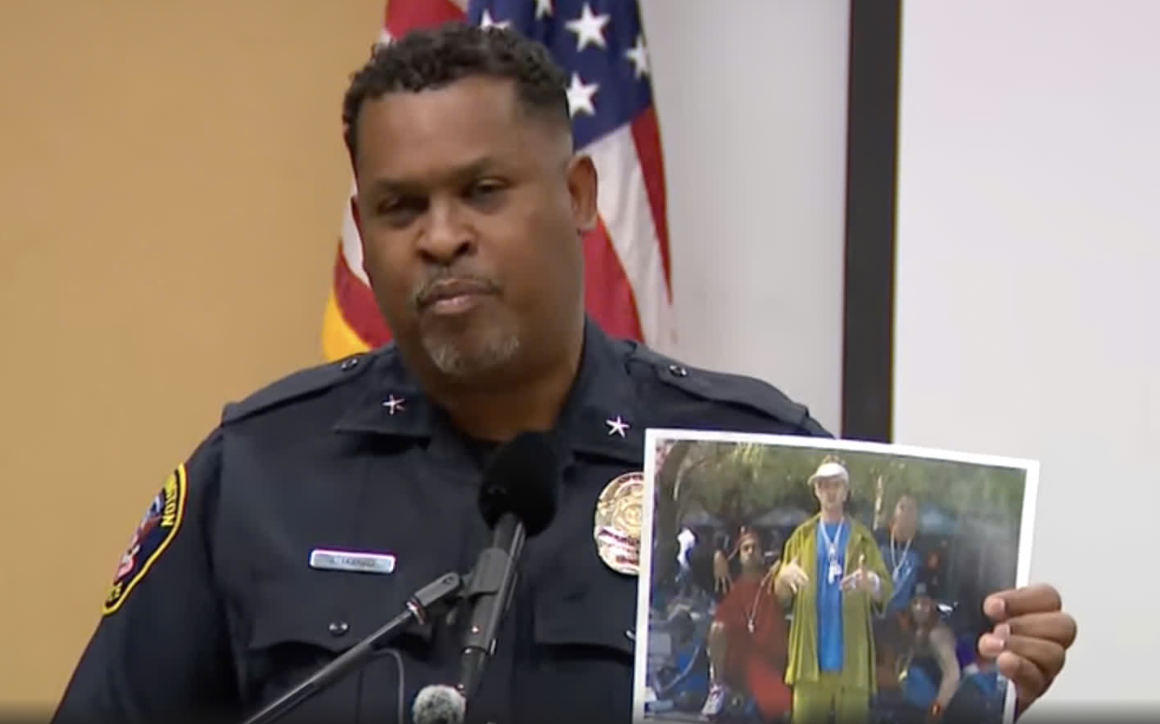
At a separate news conference in St. Paul, Ramsey County Deputy Jama Shine described the young Somali men as “very mobile.” The framing turned ordinary movement across the Twin Cities—to schools, jobs, friends, and family—into a sign of danger, portraying Somali young men as a threat that could appear anywhere.
Eden Prairie Police Chief Matt Sackett acknowledged that investigators had no evidence linking a shooting at a gas station that week to the earlier shooting outside the high school football game. Nevertheless, police described both within the same broader pattern of "Somali gang" violence.
That framing also supplied the rationale for Fletcher’s proposed regional gang task force.
A threat portrayed as everywhere demanded policing everywhere.
Fletcher and Hodges make the pitch for more police power
At the St. Paul news conference, Fletcher, flanked by gang investigators, went further. He called for the arrest of 50 of the roughly 300 young people he alleged were gang members, with 25 targeted for potential federal RICO prosecution. “We need to arrest a big chunk of these kids,” he said, “and send a message to the groups as a whole.”
Fletcher did not publicly substantiate his 300-person estimate, identify which 50 young people should be arrested, or present evidence supporting 25 potential federal racketeering prosecutions.
The broader crime data also raised questions about the scale and growth of the threat police were describing.
Just weeks earlier, the Minnesota Bureau of Criminal Apprehension reported that violent crime across the seven-county Twin Cities metro had declined 14% from 2024 to 2025.
The broader suburban crime data for the first seven months of 2026 also told a similar story about decreasing crime.
A By Design analysis of AH Datalytics police-reported crime data found that reported homicides, robberies, and aggravated assaults across six Hennepin County suburbs were 4.4% lower in January–July 2026 than during the same period in 2025, and 16.5% lower than in 2022—reaching their lowest combined level in five years.
(Minnetonka was excluded because June–July 2026 data were missing; Richfield and St. Louis Park were absent from the police-reported crime dataset compiled by AH Datalytics.)
Those declines did not disprove particular gang allegations or the seriousness of the recent shootings. They did make the claimed increase something police needed to demonstrate with actual counts of verified gang-related events, comparable over time. Those counts were not supplied alongside Fletcher's call for mass arrests.
Fletcher also blamed Hennepin County Attorney Mary Moriarty's prosecution policies for failing to contain youth violence.
Yet less than eight months earlier, Fletcher had publicly praised restorative youth justice practices in his own county as “clearly improving public safety outcomes for our youth.”

His endorsement appeared in a February 17, 2026, news release from Ramsey County Attorney John Choi’s office, announcing the results of a University of Minnesota evaluation of the county’s (Re)Imagining Justice for Youth initiative.
Among the youth studied, 4% whose first cases were resolved through community accountability faced a new criminal charge within a year, compared with 29% whose cases were handled in court.
A separate Hennepin County evaluation also found lower recidivism associated with pre-charge diversion. While the evaluations used different methods and did not establish that diversion alone caused the outcomes, both counties were pursuing the same public safety goal: reducing youth reoffending through community-based accountability and alternatives to prosecution.
Fletcher had praised that approach in Ramsey County. Now he was blaming similar policies in Hennepin County while demanding mass arrests.
And youth justice wasn't the only policy police leaders wanted changed.
Police then challenged reforms designed to curb racial profiling
At the Bloomington news conference, Hodges criticized Moriarty's policy of generally declining prosecutions arising from non-public-safety traffic stops. Pretextual stops allow officers to use minor equipment or registration violations as grounds to stop a vehicle while looking for evidence of unrelated crimes, including illegal gun possession.
The county attorney's policy, effective in October 2025, was informed by investigations of discriminatory policing. A 2022 Minnesota Department of Human Rights investigation and a 2023 federal Justice Department investigation documented racial discrimination by Minneapolis police. Federal investigators found stark disparities in stops, including a rate of stops of Black residents without citation or arrest 5.7 times the rate for white residents, adjusted for population.
Choi had introduced a similar prosecution restriction in Ramsey County in 2021. An independent evaluation of Choi's policy reported narrowing racial disparities in non-public-safety stops without a corresponding overall decline in daily firearm seizures.
Like Choi’s, Moriarty’s policy did not prevent police from stopping dangerous drivers or seizing illegally possessed guns. It limited which cases prosecutors would pursue when evidence was obtained through certain low-level traffic stops, with exceptions for compelling public safety circumstances.
Police leaders were now invoking an alleged “Somali gang” crisis to challenge prosecutorial limits adopted in response to documented racial discrimination—and to demand expanded enforcement across local, state, and federal agencies.
They were pressing for mass arrests, federal racketeering prosecutions, a regional gang task force, federal intervention and coordination, and renewed prosecutorial support for cases arising from pretextual traffic stops.
The allegations had become an argument for expanding police and prosecutorial power while challenging policies intended to address discriminatory policing.
Police chiefs escalate their public pressure ahead of the Hennepin County attorney election
That same day, the Star Tribune featured coverage of the police news conferences on its homepage alongside a story about the Hennepin County attorney election. Anders Folk and Cedrick Frazier were competing to replace Moriarty. Hennepin County Sheriff Dawanna Witt, who had stood beside Hodges at the earlier police briefing, had endorsed Folk.
Ten days later, four police chiefs serving on the executive board of the Hennepin County Chiefs of Police Association published a commentary in the Strib headlined “Police chiefs: Hennepin County needs a new head prosecutor who will partner with law enforcement.” Among its authors was Edina Police Chief Todd Milburn, who had stood alongside Hodges at the October 6 news conference.
The chiefs disclosed that their association had already met with both candidates in August. They endorsed neither. But with the election approaching, they were making their expectations public: the next county attorney should work closely with police and give law enforcement a greater voice in prosecutorial policies and decisions.
These weren't abstract arguments about public safety. Police leaders were defining an alleged regional gang threat, blaming prosecution policies for failing to contain it, and using those claims to demand a larger role for law enforcement.
The news conferences gave their demands the urgency of a growing public safety crisis. The election offered an opportunity to press for a different relationship between police and prosecutors—and greater police influence over how prosecutorial power would be exercised.
Then Came the Direct Electoral Pitch From Republicans
The electoral pitch had already become explicit before the police chiefs published their October 16 commentary.
On October 7, Fox News Radio host Guy Benson played clips of television news reports repeating police allegations about Somali gangs across the Twin Cities.
Fifteen months after Emmer accused Minnesota journalists of ignoring “Somali gangs,” those allegations were now being played back to him as news, backed by police authority.
Benson then speculated, without evidence, that alleged gang members' expensive homes and cars were financed by stolen taxpayer funds.
“No question,” Emmer replied.
Emmer described alleged gang members as “enemy combatants” and called for federal intervention to “remove them.”
Then Benson turned to the election. Could shootings reaching suburbs like Eden Prairie persuade Minnesotans who did not typically vote Republican?
Emmer saw the opportunity. Violence coming “right to your neighborhood” could “actually motivate people,” he said.
“This is going to be an issue in 27 days.”
The political stakes were high in the Twin Cities suburbs, where competitive legislative races could determine control of the Minnesota House and Senate. And Republicans were making the direct electoral appeal.
On October 9, the Star Tribune reported on Republicans' efforts to turn concerns about suburban violence into votes. Its political reporters described how candidates were emphasizing public safety as an election issue, even as some sought to distance themselves from Trump's attacks on Somali Minnesotans.
That same day, on the same newspaper's homepage, another story carried the headline “A new kind of gang violence is rattling Twin Cities suburbs.”
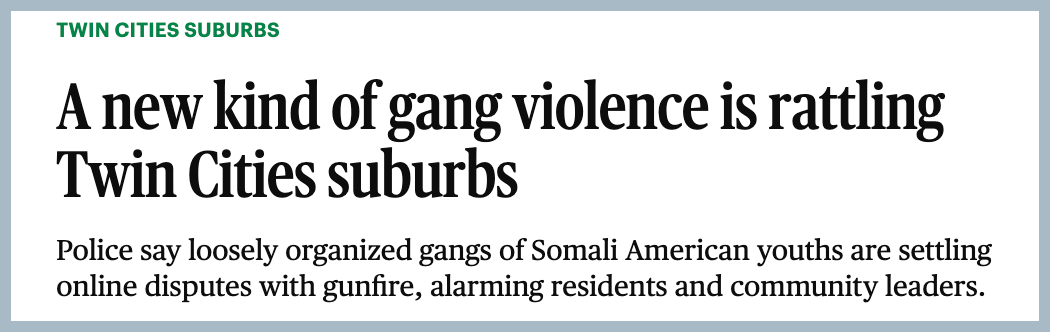
The crime story presented police allegations of a new, “mobile” Somali gang threat spreading across the suburbs, without independently establishing the scale, growth, or connections among incidents that police were claiming.
The contradiction sat on the Star Tribune's homepage for hours. Its political reporters were documenting how Republicans hoped to turn suburban fears of violence into votes. Its crime reporters were presenting the alleged threat at the center of that strategy as an emerging public safety crisis.
One story examined the electoral strategy. The other helped give its central premise the authority of news.
Whose Safety Counts?
When Fadumo Salad attended Fletcher's July meeting about violence among Somali youth, she knew what it meant to lose a child to gun violence.
Her son Mohamed had been shot and killed in north Minneapolis in April 2024. More than two years later, his eight siblings were still afraid to leave home.
“They live in fear,” she told Sahan Journal. “To this day, they tell me they don’t feel safe.”
Her son's killer had been imprisoned. But the family's need for support had not ended with the conviction. “They should do something for those of us left behind,” Salad said.
At Fletcher's meeting, Somali parents and neighbors spoke about violence and the fear it had brought into their homes. Some welcomed his attention. Others challenged his decision to define the problem by ethnicity, warning that it would expose young people to collective suspicion and profiling.
Their accounts did not fit neatly into a choice between acknowledging violence and rejecting racial scapegoating. They were trying to protect their children from both.
Those concerns grew more urgent in October. After Trump urged Minnesotans to “fight back” against Somali immigrants, mosque leaders reviewed security arrangements. Neighbors offered to resume patrols outside mosques and Somali businesses—precautions familiar from Operation Metro Surge.
At Dar al-Farooq mosque in Bloomington, bombed by far-right attackers in 2017, Imam Abdulahi Farah warned: “Scapegoating is not a public safety strategy.”
Somali community leaders were also calling for responses to youth violence that included accountability for shootings, support for survivors and grieving families, opportunities for young people, and prevention that could keep them safe without putting an entire community under suspicion.
These were demands for public safety from people living with the consequences of violence.
Yet in the Star Tribune's reporting, police and political officials held far greater authority to define the threat and what should be done about it. Somali Minnesotans were largely left responding to accusations about their community, rather than being heard as authorities on the violence, its causes, and what their own safety required.
Including community objections did not, by itself, challenge the premise of the coverage. When “Somali gang violence” became the organizing category, ethnicity could serve as the connection between separate crimes, even where the alleged gang relationships had not been established.
The responsibility to examine that premise belonged to the newsroom, not to the people being subjected to it.
Fadumo Salad had come to Fletcher's meeting asking what officials would do for families like hers, still living with the loss of a child to gun violence. The public campaign that followed centered a different response: more profiling, more targeting, more arrests, more prosecutions, and more police power.
Crimes committed by particular people cannot justify treating an entire ethnic community as a criminal threat. Yet that was the leap police and politicians were asking Minnesotans to make—and the Star Tribune helped give it the authority of news.
Tracing How “Somali Gangs” Rhetoric Became Crime News—and an Election-Year Campaign for Expanded Enforcement
From Emmer's challenge to Minnesota journalists to Fletcher's police allegations, crime headlines, and Republican electoral appeals, follow how a racialized political narrative gained authority—and became an argument for mass arrests and expanded enforcement.
Constructing the threat | July 2025–February 2026
Republican leaders link allegations of gang violence and fraud to Somali Minnesotans, challenge journalists to report an alleged threat, and demand federal enforcement and removal.
July 17, 2025
Emmer warns of “dangerous Somali gangs” and accuses Minnesota journalists of ignoring the threat
On Fox Business, Rep. Tom Emmer cites an assault at Cooper High School and a shooting at Mariucci Arena and says "Somali gangs" are a public-safety threat in Minnesota. He accuses Minnesota journalists of failing to report the problem, challenging newsrooms to give his ethnic framing of crime greater attention.
Source: Minnesota Reformer
July 25, 2025
The Star Tribune challenges the gang connections Emmer alleged
The newspaper examines the records behind Emmer’s examples and challenges whether they establish the gang affiliations he asserted. Its fact-check treats Emmer's ethnic gang allegation as a claim requiring evidence.
Source: Star Tribune
November 21, 2025
Trump links “Somali gangs” and fraud allegations to demands for immigration enforcement and removal
Trump declares that “Somali gangs” are terrorizing Minnesota, claims "billions of dollars" are missing, and says he will end Temporary Protected Status for Somalis in the state. He turns allegations against particular people into a rationale for withdrawing immigration protections from Somali TPS holders.
On December 2, he escalates his rhetoric: “I don’t want them in our country.”
Source: Reuters
December 2025–February 2026
Federal immigration enforcement expands across Minnesota
Operation Metro Surge brings expanded federal immigration enforcement into Minnesota communities, including roughly 4,000 federal agents at its peak.
Later reporting on ICE’s internal data finds that roughly three-quarters of those arrested had no criminal convictions; 63% had neither convictions nor pending criminal charges. The operation's consequences become the subject of extensive Minnesota news coverage.
Source: MPR
The threat gains police authority | July–August 2026
Fletcher supplies numerical claims and an incident list, giving the ethnic crime narrative the appearance of investigative evidence as reporters circulate the allegations.
July 6–10, 2026
Ramsey County Sheriff Bob Fletcher gives the “Somali gangs” frame narrative police authority and supplies newsrooms with purported evidence
In a July 6 livestream, Fletcher claims that 14 homicides and more than 100 shootings involving Somalis over two years were all gang-related. His office estimates roughly 300 young people across about 12 gangs.
Fletcher supplies the Star Tribune with an incident inventory, which the newspaper describes as “more than 100 criminal cases believed connected to the alleged gangs." The published document, titled “East African Violence Timeline,” contains police summaries and claimed associations.
Fletcher's official position, numerical estimates, and incident list give the political narrative the appearance of investigative substantiation, although the document's contents do not independently establish his broader claims.
Source: Star Tribune
July 21, 2026
Somali residents warn that Fletcher's ethnic framing creates profiling
At a community meeting convened by Fletcher, Somali residents discuss concerns about youth violence while challenging Emmer's decision to frame the threat by ethnicity. Community members warn that his language places Somali young people under collective suspicion amid ongoing political attacks.
Imam Hassan Jama asks Fletcher to apologize for singling out Somalis. Fletcher refuses, crediting his remarks with bringing attention to the issue.
Source: Sahan Journal
July 23, 2026
Emmer uses Fletcher's figures to demand a federal crackdown
Emmer leads Minnesota's Republican congressional delegation in urging U.S. Attorney Daniel Rosen to “stamp out Somali gang violence.”
His release repeats Fletcher's estimates of 300 gang members, 14 murders, and more than 100 shootings, connecting the allegations to fraud and demands for assimilation.
“If you won't assimilate, then get the hell out of here,” Emmer declares.
Source: Emmer congressional release
The threat turns into a Minnesota election campaign | October 2026
Police warnings appear in crime headlines and demands for mass arrests and regional enforcement, while Republican officials connect the alleged threat to electoral mobilization.
October 3, 2026
Emmer labels the Eden Prairie shooting “another Somali gang crime”; the Star Tribune uses his claim as context
Emmer calls the shooting outside Eden Prairie High School’s homecoming football game “another Somali gang crime.”
Police had described the shooting as targeted, without publicly identifying suspects or a specific gang. The Star Tribune includes Emmer's accusation in its reporting alongside Fletcher's earlier warnings, placing the incident within the broader ethnic crime narrative both officials were promoting.
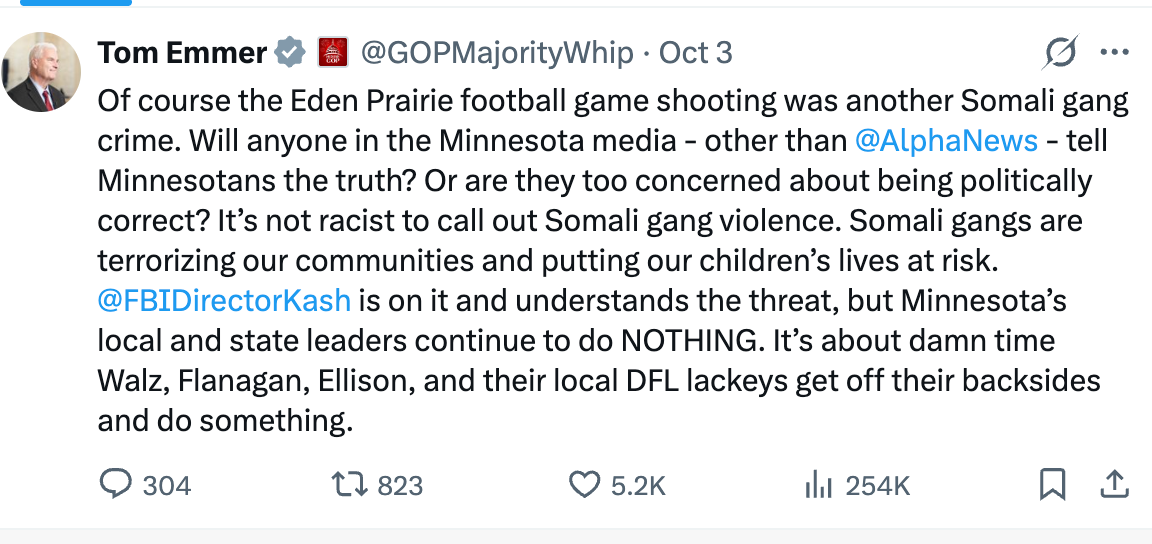
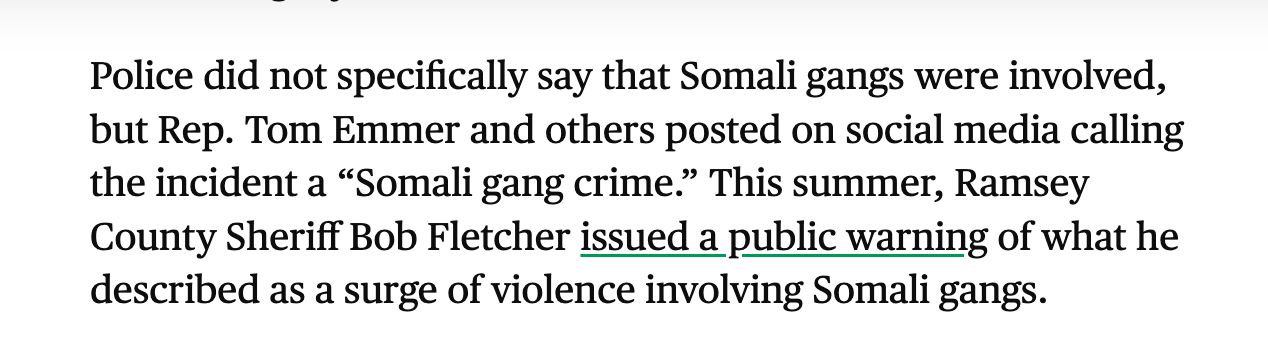
October 6, 2026
The Star Tribune names “Somali gang violence” in its own headline
“Eden Prairie shooting renews concern over Twin Cities Somali gang violence.”
Source: Star Tribune
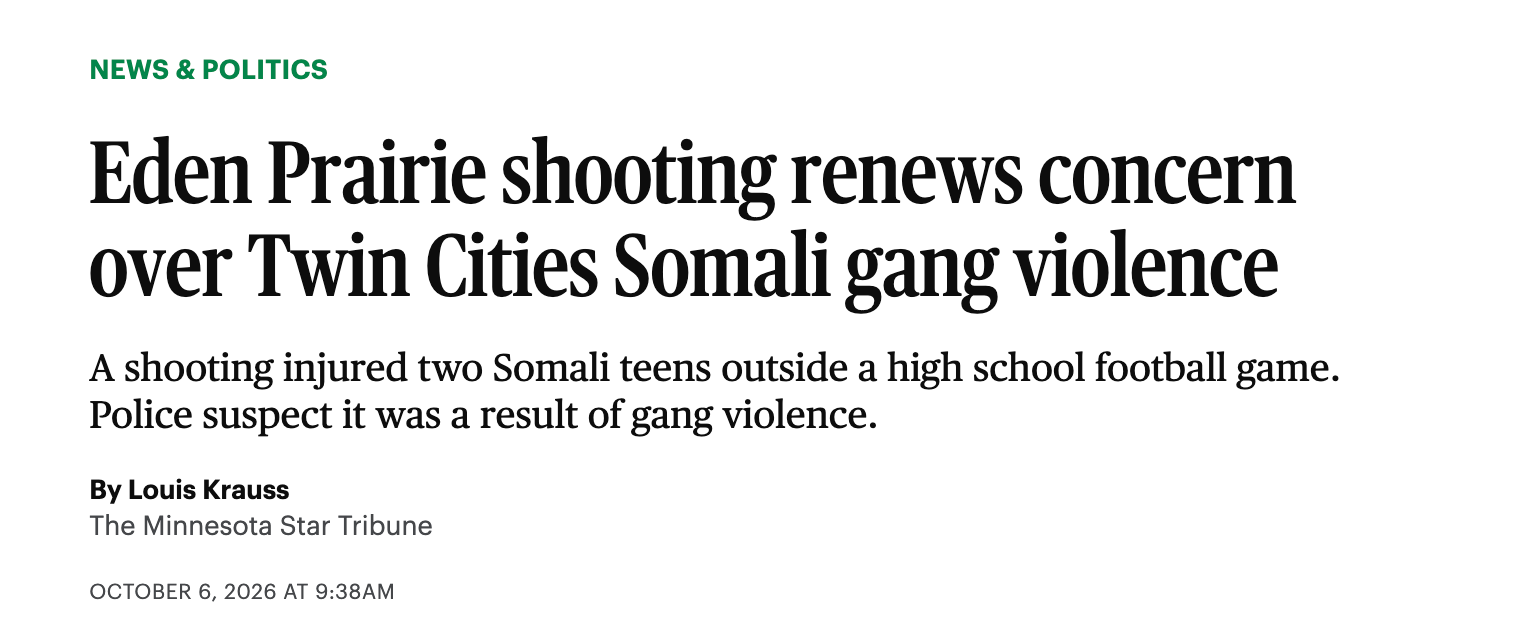
October 6, 2026
Fletcher demands 50 arrests and a regional task force while attacking Hennepin County prosecutors
Fletcher calls for arresting 50 of the approximately 300 young people he alleges are gang members, with 25 prosecuted federally under RICO and another 25 prosecuted locally. He claims removing the most active would dramatically reduce crime. He also presents arrests as a warning: “We need to arrest a big chunk of these kids and send a message to the groups as a whole.”
Source: Fox 9
October 7, 2026
Emmer calls alleged gang members “enemy combatants” and connects suburban shootings to mobilizing voters
On Fox News Radio, Emmer calls alleged gang members “enemy combatants.” Discussing suburban shootings and politically disengaged voters, he says: “With this starting to happen and come right to your neighborhood, I think this could actually motivate people.” He pledges to keep attention on the issue through the approaching election.
Source: Fox News Radio
October 7, 2026
The Star Tribune frames a terrorism charge through concerns about Somali gang violence
The newspaper places a federal terrorism charge against Sheikhdoon Abdullahi Mohamud within a broader discussion of gang violence involving Somali Minnesotans.
U.S. Attorney Daniel Rosen says Mohamud acted alone and was not gang affiliated.
The article does not allege that Mohamud belonged to a gang. Its framing nevertheless makes the broader ethnic crime narrative part of the context readers receive about an unrelated terrorism case.
Source: Star Tribune
October 8, 2026
Trump targets Somali immigrants collectively and urges Minnesotans to “fight back”
Trump portrays Somali immigrants as taking over Minnesota and urges residents to “fight back.” He offers expanded federal intervention if requested by local authorities.
His statements escalate the collective targeting of Somali Minnesotans as the election approaches.
Source: NBC News
October 9, 2026
Somali leaders organize for safety as Trump, Emmer, and other political leaders escalate anti-Somali rhetoric
CAIR-MN convenes imams to discuss mosque security, emergency exits, and safety procedures. Neighbors offer to resume protective patrols outside mosques and Somali businesses—measures taken months earlier during Operation Metro Surge.
Imam Abdulahi Farah of Bloomington's Dar al-Farooq mosque warns:
“Scapegoating is not a public safety strategy.
Source: MPR News
October 9, 2026
The Star Tribune reports on Republicans’ electoral strategy while publishing another story about a spreading Somali gang threat
The newspaper reports on Republican candidates' efforts to turn suburban concerns about violence into votes. That same day, its crime coverage presents police allegations of a new, mobile Somali gang threat spreading across Twin Cities suburbs without independently establishing the claimed increase or connections among incidents.
One story examines the electoral strategy. The other gives its central premise the authority of crime news.
Sources: Star Tribune political coverage · Star Tribune crime coverage
October 13, 2026
Hennepin County attorney candidates clash over prosecution policies
At a public debate, Anders Folk attacks Mary Moriarty's prosecution policies and ties opponent Cedrick Frazier to her administration. Folk invokes recent shootings in Bloomington and Eden Prairie while arguing for a different prosecutorial approach. Frazier challenges Folk's ties to the Trump administration and emphasizes reducing racial disparities, diversion, and support for crime victims.
The dispute puts the future of prosecution policy directly before voters, days after police leaders demanded expanded enforcement and criticized Moriarty's office.
Source: Minnesota Spokesman-Recorder, October 19 reporting on the October 13 debate
October 16, 2026
Hennepin County police chiefs publicly press for greater influence over the next county attorney's prosecution policies
Four police chiefs serving on the executive board of the Hennepin County Chiefs of Police Association publish a Star Tribune commentary calling for a new county attorney who will partner more closely with law enforcement.
Among the authors is Edina Police Chief Todd Milburn, who stood alongside Bloomington Chief Booker Hodges at the October 6 news conference. The chiefs criticize Moriarty's prosecution policies and their exclusion from policy decisions. They disclose that their association met with both candidates in August but endorse neither.
The commentary does not invoke “Somali gangs.” It documents police leaders' broader election-year demands for greater involvement in determining how Hennepin County prosecutes crime.
October 19, 2026
State, federal, and local agencies announce coordinated gang enforcement strategy
Leaders representing 46 law enforcement agencies announce an expanded intelligence-sharing and investigative response through Minnesota's Crime Gun Intelligence Center, involving the BCA, FBI, ATF, and local departments. The Star Tribune reports that Sheriff Bob Fletcher now claims there are 13 Somali gangs in the area, up from the 12 he identified in July.
Source: Star Tribune
.