How MPD Built a Police Surveillance Operation Around Renee Good’s Memorial — and What It Cost the Community
MPD records reveal a coordinated system of drones, city cameras, command-post intelligence, body-worn and helmet cameras, person and vehicle checks, and evidence preservation around the memorial site as part of a four-day police operation that generated $1.92 million in overtime. At least 101 MPD personnel were assigned to the deployment at the memorial, where records show only seven people were holding vigil.
What MPD left behind was more than an huge overtime bill. The operation created a law-enforcement evidence record of people and activity around the memorial at a moment when law-enforcement agencies were monitoring anti-ICE activity and federal investigators were pursuing cases involving alleged interference with federal officers. That gave information collected by a local police operation potential significance beyond the morning it was gathered — and beyond MPD itself.
Before Dawn on Portland Avenue
At 3 a.m. on Jan. 9, 2026, Minneapolis police were staging across South Minneapolis for a predawn operation at 34th Street and Portland Avenue, where an ICE agent had shot and killed Renee Good less than 48 hours earlier.
Second Precinct squads gathered at 26th Street and Hiawatha Avenue. More officers coordinated at 32nd Street and Nicollet Avenue. A Fifth Precinct supervisor deployed seven squads along 35th Street from Oakland Avenue to Fifth Avenue. Others took positions at 31st and Portland, 32nd and Portland, 33rd and Columbus, and 34th and Oakland. A police drone crew set up several blocks south of the memorial, in the rear lot at 330 East 38th Street.
In all, a manual count of MPD’s dispatch roster identified 101 named personnel and 44 assigned units or call signs attached to the operation, drawing officers from multiple precincts and specialized units across the department, including Strike Teams, SWAT, drone crews, booking officers, and command staff.
At the center of that deployment was a small group of people who had remained at Good’s memorial through the night, keeping vigil.
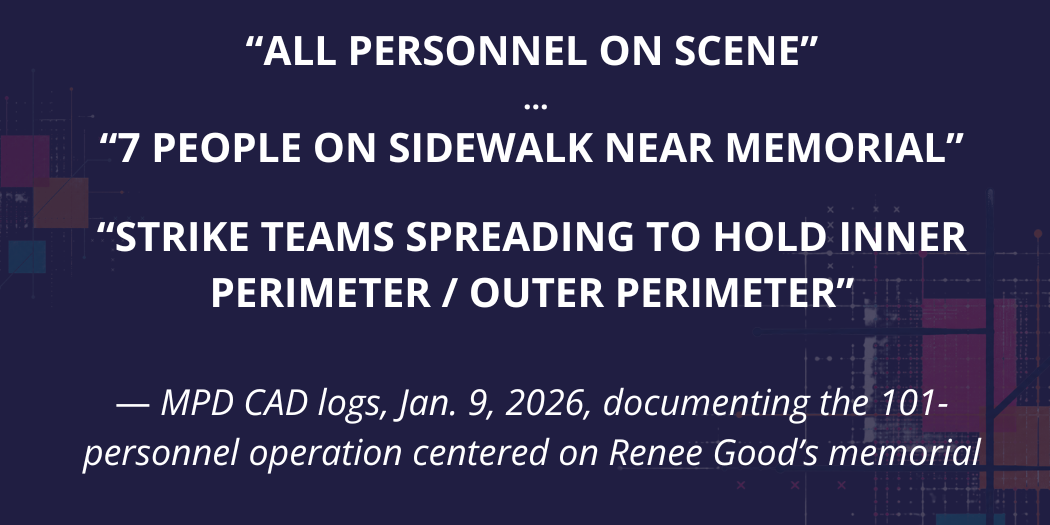
MPD’s own records describe what officers encountered when they moved in. A Strike Team supervisor wrote that “approximately 8 people were inside the block,” while dispatch separately recorded “7 people on sidewalk near memorial” as Strike Teams spread out to hold inner and outer perimeters.
The deployment was part of Operation Trust and Safety, MPD’s department-wide response to Good’s killing and its aftermath. From Jan. 8 through Jan. 11 alone, MPD later put the citywide operation’s overtime cost at $1.92 million—nearly as much as the department had allocated for overtime for the entire year.
The scale of the Jan. 9 operation opens up larger questions about where MPD directed those resources and what the department chose to track, investigate, record, and preserve as evidence in the first days after Good’s killing and during Operation Metro Surge.
Around Good’s memorial that morning, where seven people remained, a single misdemeanor citation issued there would become a 117-page police case file, while officers recorded from the ground and air, ran vehicles and people through police systems, and logged license plates around the surrounding blocks.
While MPD was devoting extensive personnel and surveillance resources around Good’s memorial, some of the city’s highest-priority calls waited nearly an hour for officers, including domestic-abuse calls. Residents were also calling 911 about encounters with federal immigration agents.
At the time, MPD was already operating under a special order from Chief Brian O’Hara requiring officers to document apparent excessive force or suspected civil-rights violations they witnessed by federal agents. Those reports were to be tracked under a dedicated “ICEF” code. MPD would later tell the City Council it had produced "zero ICEF reports" during all of Operation Metro Surge.
Against that zero, the scale of what MPD did document during that time period becomes especially clear in the records from 34th and Portland that were collected in only a matter of hours.
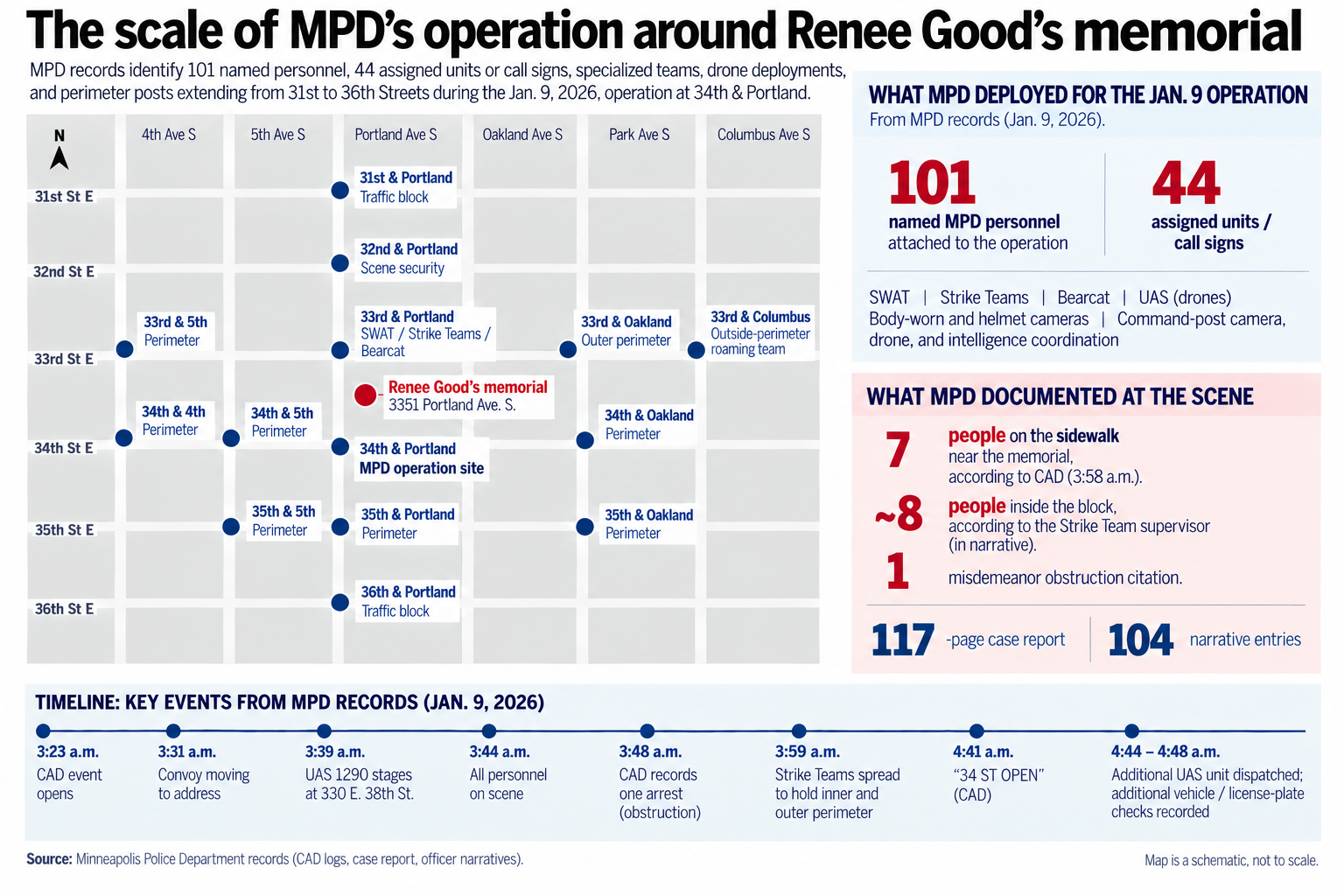
MPD’s formal dispatch event opened that morning at 3:23 a.m.
Eight minutes later, the CAD log recorded: “Convoy moving to addr.” Then: “Leads on Portland.” “Squads arriving.”
At 3:44 a.m.: “All personnel on scene.”
What officers understood that operation to be accomplishing, however, was not described the same way throughout MPD’s records. Some reports said the operation was to remove barricades, reopening the roadway, and allowing Public Works and emergency vehicles access. Others described a need for “securing the area” and “maintaining inner and outer perimeters.” The drone reports identified still another function: conducting a “threat assessment” and "evidence collection" from the public area surrounding the site.
Those purposes could overlap. But the records do not offer one consistent account tying them together or explaining why clearing the intersection required the full combination of 101 MPD personnel, tactical units, equipment, surveillance, intelligence gathering, and evidence collection MPD deployed that morning.
In the hours after Good was killed, community members transformed 34th and Portland into a memorial site, filling it with photos, drawings, flowers, candles, signs, and handwritten tributes, while makeshift barricades blocked vehicle traffic around the intersection. MPD records described roadblocks on 34th Street immediately west and east of Portland Avenue, as well as another barricade at 33rd and Portland. Officers described pallets, Christmas trees, garbage cans, boards, and other objects across the roadway. That morning, they began moving the material themselves, clearing enough space for police vehicles to pass. Public Works moved in after police secured the area and continued clearing "leftover trash."
One man began putting pieces back as officers removed them. Officers wrote that he ignored their directions to stop and leave the area and at one point grabbed “a large piece of plywood.” Officers took him into custody for obstruction. Booking officers put the arrest at approximately 3:52 a.m. He was issued a misdemeanor citation, driven to his vehicle at Park Avenue and 34th Street, released from handcuffs, and told to leave the area.
He was the only person arrested.
For hours after, the operation continued producing an evidentiary record that extended far beyond the person police had cited.
At the command post, an officer assigned as the operation’s “Deputy Planning Section Chief” wrote that he was coordinating “camera footage, drone footage, and intelligence.” Officers positioned around the perimeter recorded on body-worn cameras.
SWAT added another layer. Officer Joseph Fonseca wrote that his primary role was as a “40mm operator.” The records show he exited an armored Bearcat with his 40mm—a launcher used to fire impact projectiles intended to incapacitate or control a person from a distance—held the perimeter, and recorded with both a body-worn camera and a helmet camera.
Above the scene, MPD was collecting aerial footage. Officer Lance DuPaul wrote that he had been assigned as the “Air Boss” and visual observer for all UAV (Unmanned Aerial Vehicle) flights occurring during the detail.
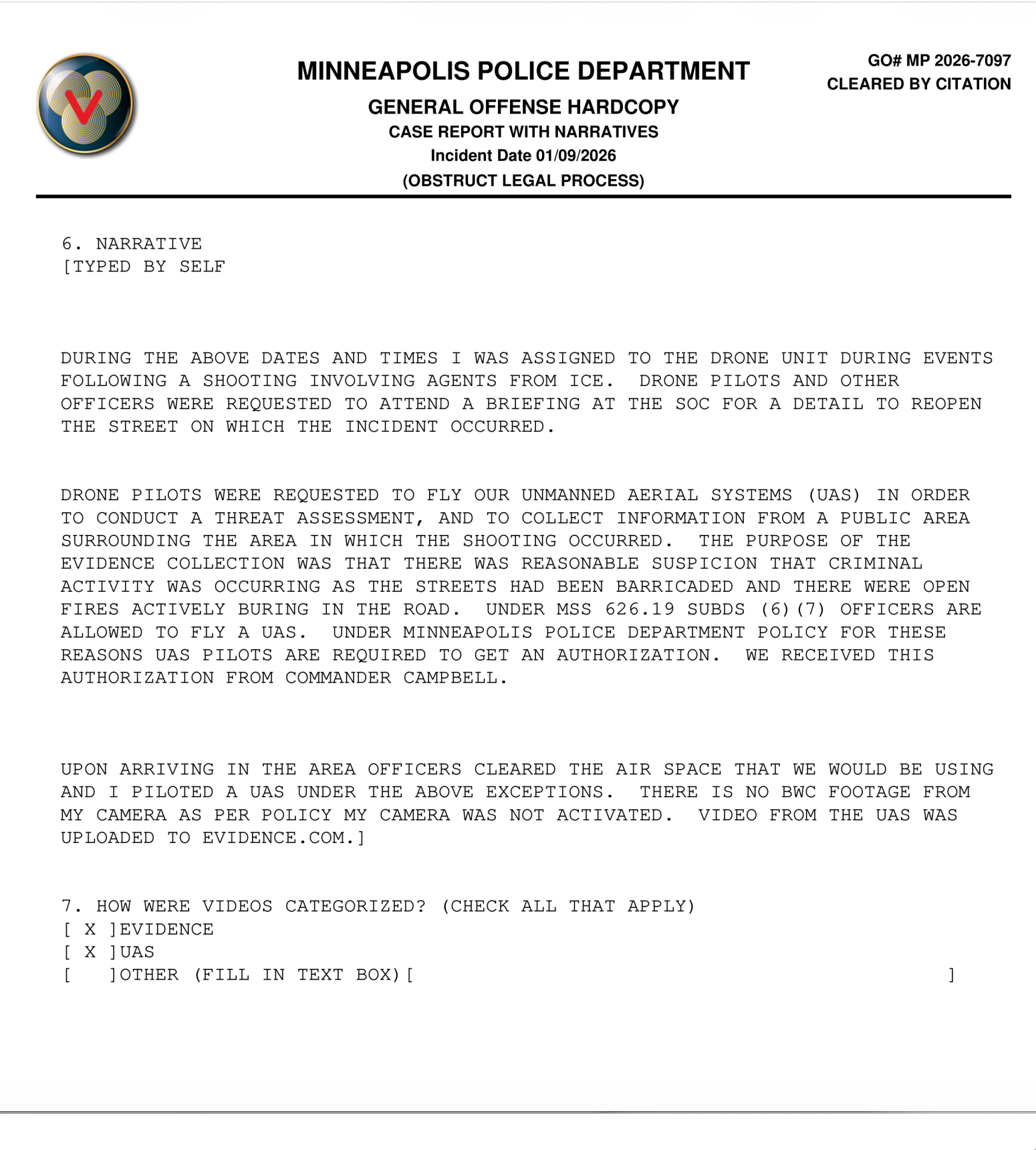
MPD’s written mission for the drones was not limited to the street clearance. One pilot wrote that operators had been instructed to conduct a “threat assessment” and “collect information from a public area surrounding the area in which the shooting occurred.”
Those phrases matter under Minnesota’s drone law. The law generally prohibits police from using drones to collect data on public protests or demonstrations without a warrant unless a specific statutory exception applies. Among those exceptions are conducting a “threat assessment in anticipation of a specific event” and collecting information from a public area based on “reasonable suspicion of criminal activity.”
MPD’s drone report invoked that same reasonable-suspicion standard, stating there was “reasonable suspicion that criminal activity was occurring” because streets had been barricaded and “open fires” were “actively burning in the road.”
Additional reporting provides deeper context of those fires. Sahan Journal reported that firefighters were extinguishing a few remaining warming fires burning in barrels at the memorial. MPD’s own real-time dispatch log described them more simply as “a couple fires” and called the Fire Department to extinguish them.
Minnesota law also requires law enforcement to document each UAV use, connect each deployment to a unique case number, identify the factual basis and applicable exception, and generally delete UAV data within seven days unless it becomes part of an active criminal investigation.
The morning of Jan. 9, there was no case number attached to the operation. Yet MPD later tied the Jan. 9 drone deployments and footage to the single misdemeanor case, classified the recordings as “evidence,” and uploaded the footage to Evidence.com.
The evidence collection and storage was not limited to video.
At 4:10 a.m., the CAD log recorded a person check near 34th Street and Fifth Avenue. Vehicle checks and license-plate entries continued around Oakland, Fifth, and Park avenues.
By 4:41 a.m., dispatch reported “34th street open.” A little more than a minute later, cleanup was three-quarters complete, officers were told to hold their positions, and the log noted: “Not seeing any foot traffic at this time.”
But the surveillance and data collection did not end once the street was open.
At 4:44 a.m., another drone unit was dispatched toward the intersection. At 4:48, officers entered additional license-plate and vehicle checks at 34th Street and Fifth Avenue.
By the time MPD finished documenting the morning, one single misdemeanor obstruction citation would generate a 117-page case file containing 104 narrative entries, four UAS reports, body-worn and helmet-camera recordings, drone video, person and vehicle checks, license-plate information, and other material preserved as evidence.
The underlying misdemeanor case was ultimately marked “cleared by citation” and later expunged. By then, however, the operation had already created a much broader law-enforcement record of the people and activity surrounding Good’s memorial.
Nearly a year’s overtime budget in four days
The day after Good was killed, MPD commanders were already planning to clear the intersection where community members had built a memorial for her.
At around 3 p.m. on Jan. 8, Deputy Chief Mark Klukow emailed Chief Brian O’Hara and Assistant Chief Katie Blackwell that, “As directed,” Commander Thomas Campbell was working on a plan to clear the intersection “every day through Sunday morning.”
The plan was expected to be finished by 5 p.m. that day and still required review and approval from O’Hara and Blackwell. Klukow said the plan contemplated using Minnesota State Patrol personnel, which would require a chief-to-chief request. He asked whether either chief wanted to provide input while Campbell built the plan. The email does not identify who issued the original direction.
In his own police narrative of the Portland operation filed the next day, Klukow described Operation Trust and Safety as a “department-wide initiative” and identified himself as its Incident Commander. He wrote that he and Commander Thomas Campbell worked from an Incident Command Room, where “we monitored and directed” as officers moved onto Portland Avenue.
MPD’s later retrospective presentation identifies Jan. 7 through Jan. 11 as the Operation Trust and Safety period, when the department canceled all days off, integrated outside agencies, established procedures for sustained deployments and “hotel protection” where ICE and DHS officers were staying, and cleared roadway barriers. But MPD’s own cost memos written at the time continued tracking overtime under Operation Trust and Safety after Jan. 11, with costs accumulating through at least Jan. 25.
Within four days, Operation Trust and Safety overtime costs would approach what MPD had allocated for overtime for the entire year. The department’s overtime records do not isolate the cost of the Portland Avenue operation from the larger MPD response over that four-day period. But they do show where MPD was directing its capacity and overtime while some of the city’s highest-priority calls were waiting extended periods for officers.
On Jan. 12, Commander Renee Lewis sent O’Hara an internal review of Priority 1 calls from Jan. 3 through Jan. 9. Fourteen had remained pending for more than 30 minutes. Six involved domestic abuse. One domestic-abuse call came in at 11:58 p.m. on Jan. 7 and waited 56 minutes for an officer, carrying the delay into Jan. 8.
Lewis told O’Hara she had reviewed several of the domestic-abuse calls and concluded: “It seems that these kinds of calls could use more attention.”
Four days later, O’Hara’s own accounting showed the continued costs of the operational choices MPD had already made.
On Jan. 16, O’Hara sent a memorandum to Office of Community Safety Commissioner Toddrick Barnette estimating that Operation Trust and Safety had generated between $2.04 million and $2.47 million in overtime from Jan. 8 through Jan. 11 alone. MPD’s entire fiscal-year overtime allocation was $2.265 million. Mayor Jacob Frey and City Council President Elliott Payne were copied on the memo.
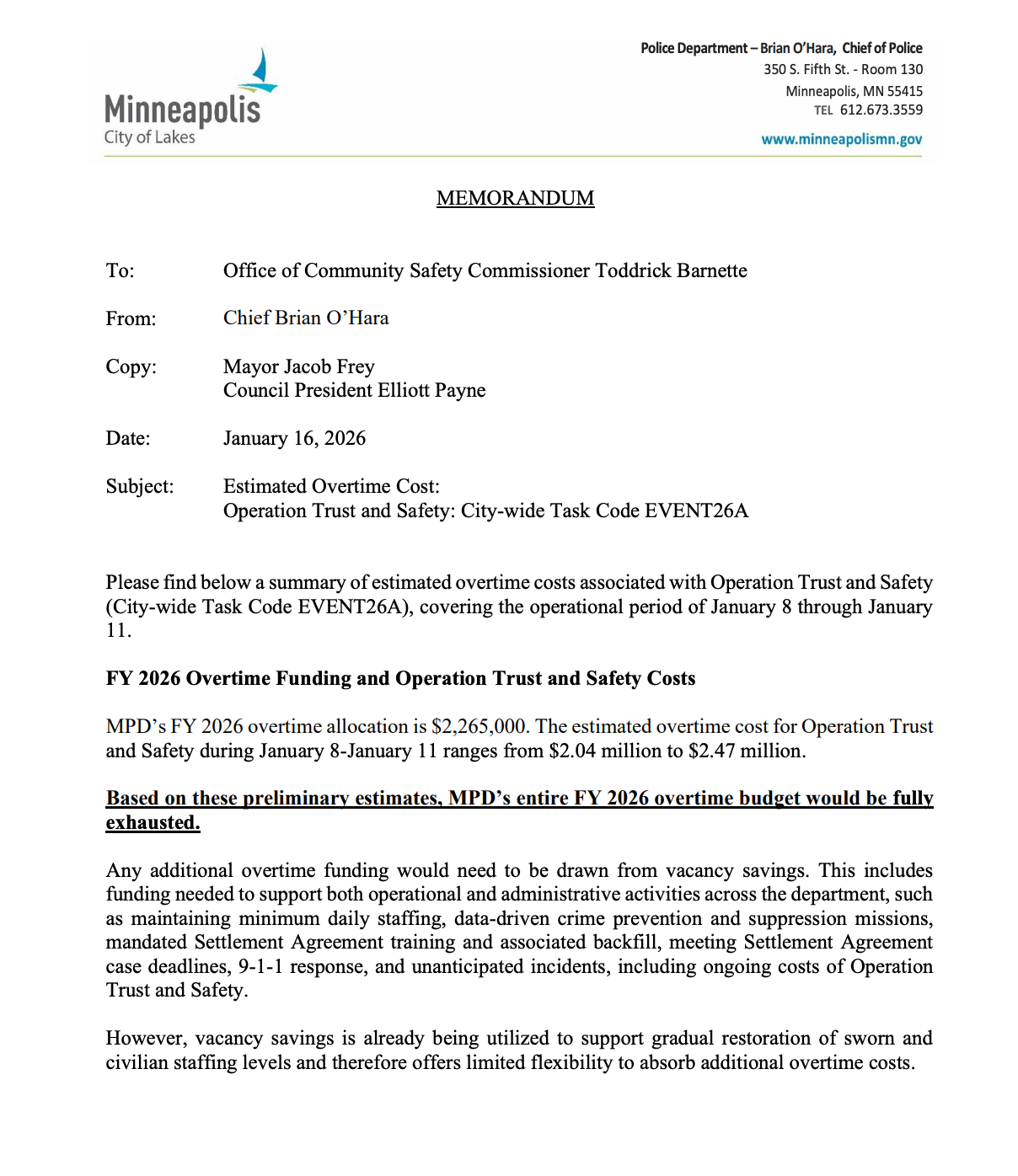
In the same memo, O’Hara warned that once the overtime allocation was exhausted, additional spending would have to come from vacancy savings. Yet records show MPD had already made the staffing and deployment decisions that produced those costs, including the large-scale operation on Portland Avenue.
Six days later, on Jan. 22, MPD reconciled its Jan. 8–11 estimate downward to $1.92 million—still roughly 85 percent of the department’s entire annual overtime allocation in four days. By then, however, O’Hara estimated total Operation Trust and Safety overtime had now reached $3.02 million, with the operation still underway.
On Jan. 29, O’Hara told Barnette the operation was now “affecting all staffing.” MPD estimated that Operation Trust and Safety had generated $4.32 million in overtime through Jan. 25—nearly twice its annual overtime allocation—with additional costs still expected.
Frey was copied on the Jan. 16, Jan. 22 and Jan. 29 overtime memoranda as the reported cost of the operation climbed from as much as $2.47 million after its first four days, to $3.02 million, and then to $4.32 million in less than a month.
MPD’s reliance on extraordinary overtime was not new.
For years, MPD had operated with fewer sworn officers than before 2020 while using overtime to fill what department leaders described as staffing gaps. But a smaller force did not translate mechanically into higher crime or more police calls. In 2023, active MPD staffing fell to 565 while violent crime declined for the second consecutive year; murders, robberies, shootings and carjackings all fell from 2022 levels.
What was undeniably rising was overtime. MPD spent about $28 million on overtime in 2024, $12 million more than planned. In 2025, overtime climbed again, to $32.9 million, helping push MPD $21.1 million over its overall department budget.
Frey had already identified police overtime as a serious cost problem for the city. In his 2026 budget proposal, delivered in August 2025, he called for ending double overtime for MPD, describing it as a way to save money while continuing to meet the city’s public-safety obligations.
By the time Operation Trust and Safety began, MPD’s staffing numbers and the department's consistent heavy reliance on were not unforeseen conditions. They were part of the operating environment the department said it had been managing for years. The question, then, was not whether staffing and overtime were constrained, but how Frey and MPD would allocate the personnel and overtime available to a vast operation that already appeared to have no oversight or guardrails.
In August 2026, Frey stated in a budget address that the city’s original $2.3 million 2026 overtime allocation did not "come anywhere close" to MPD’s "true costs." He said he had directed MPD to review all overtime hours and create a strategy prioritizing shifts needed to maintain minimum staffing, respond to 911 calls, and solve crimes.
His directive came seven months after MPD’s January records had already shown where the department was directing its personnel and overtime.
On Sept. 15, City Council members sought answers about MPD’s roughly $21 million 2025 department-wide budget overrun. MPD leaders did not appear for the scheduled response, leaving council members without an in-person presentation or an opportunity to question department leadership. Reporting on the meeting said the absence followed Frey’s direction that departments respond to legislative directives through “written memos” rather than sending leaders to appear in person.
The January records show how those resource decisions unfolded, where MPD concentrated officers, overtime, and surveillance capacity, and what remained pending elsewhere.
They also document a starkly different response to residents calling 911 about federal immigration agents, even as MPD was operating under a newly revised policy governing officers’ response to federal immigration activity.
“No response to this”
While MPD was devoting personnel, surveillance, and overtime to Operation Trust and Safety, its own command logs show the department was also tracking federal immigration activity across Minneapolis while not responding to 911 calls about their increasingly aggressive tactics putting community members in direct danger.
Shortly before 11am on the morning of the Portland Avenue operation, a 911 caller reported that someone had been “grabbed from a bus stop by ICE” in Northeast Minneapolis.
The MPD log recorded: “No response to this.”
The entries continued throughout the day.
MPD’s Downtown Radio Operations Center, or DROC, watched what it described as a three-car federal detail near HCMC and Elliot Park. Officers monitored an ICE SUV conducting a “knock and talk” at an apartment building. At Cedar-Riverside, DROC watched ICE vehicles and protesters. Near Central Avenue, the log recorded a vehicle stop involving an estimated 10 to 15 federal agents and 20 to 25 protesters.
At 11:51 a.m., a 911 caller reported a personal-injury crash at 22nd Street and Chicago Avenue. MPD cameras showed what the command log called a “large ICE contingent.” The log says: “Once ICE cleared officers moved in” and assessed the people at the scene.
At 12:39 p.m., another report of ICE activity was “immediately transferred to command.” Shortly after 1 p.m., DROC was using cameras to monitor a large Border Patrol contingent moving through the city.
Then came reports of physical force by federal agents.
At 1:50 p.m., a caller said they had been “assaulted by ICE.” MPD reviewed video “to verify,” but the Watch Commander response field is marked “No.” The log contains no subsequent entry documenting what the video showed, an officer being dispatched, an investigation being opened or another response.
At 3:07 p.m., a 911 caller reported that ICE had someone “pinned on the ground.” The Watch Commander response field is marked “No,” and the action field records no other response.
Another caller said Homeland Security Investigations agents had followed them home and taunted them. The log says “No response,” and the Watch Commander field is marked “No.”
At around 3:30, a 911 caller reported federal agents on site at Washburn School, just two days after U.S. Border Patrol agents had converged on Roosevelt High School during dismissal, where agents tackled people, handcuffed two staff members, and deployed chemical irritants into the school crowd. The log again says "no response," and Watch Commander field is again marked "No."
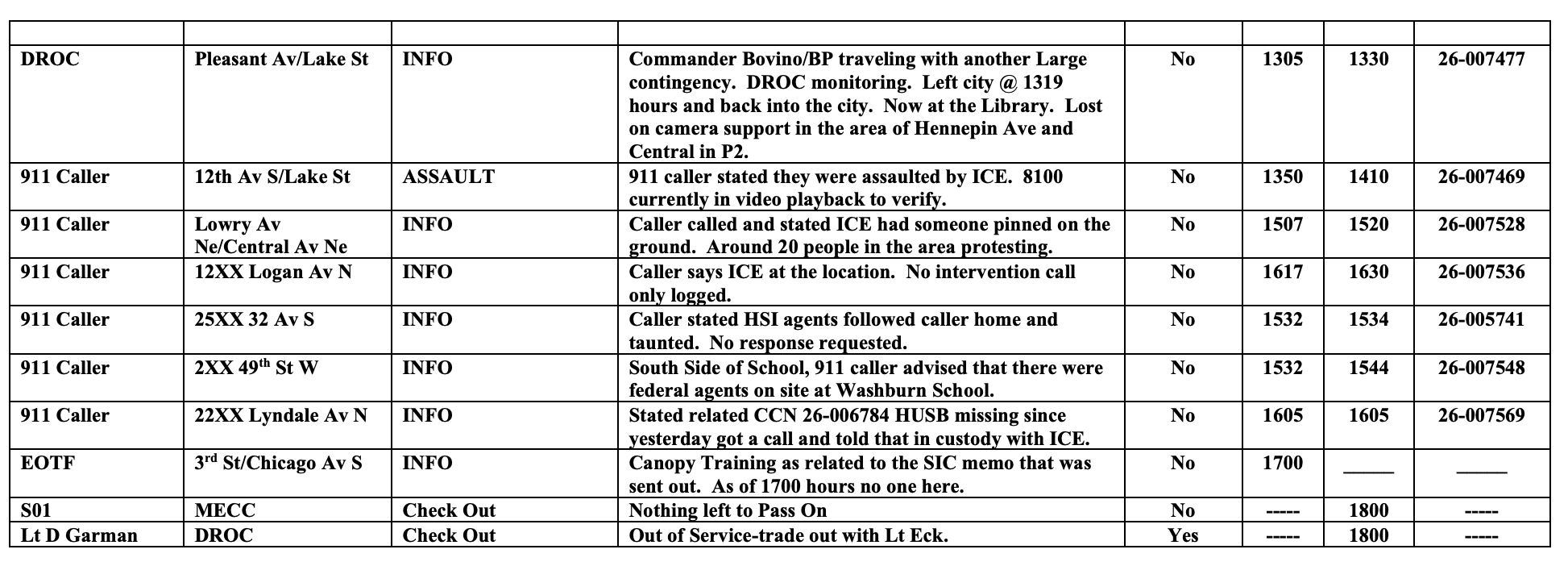
Taken together, the entries show MPD had substantial real-time visibility into federal immigration activity that day. Officers and command staff monitored federal agents through city cameras, verified their presence, reviewed video, logged allegations, and referred some incidents to command.
What the command log does not document is an MPD officer intervening or responding to any of the threats or alleged misconduct described in these calls.
And MPD already had a written policy spelling out what officers were required to do when they personally witnessed conduct by federal agents that raised excessive-force or civil-rights concerns.
Zero ICEF reports
On December 18, just three weeks before Good was killed, O’Hara had issued a Special Order, updating MPD Policy 9-401, Police Authority in Immigration Matters, and spelling out how Minneapolis officers were to respond when federal immigration agents were operating in the city.
The policy prohibited MPD officers from participating in federal immigration enforcement. It said crowds responding to immigration operations were to be treated like other First Amendment-protected events and reminded officers that people had the right to record, observe and object to law-enforcement activity.
It also imposed specific obligations when Minneapolis officers witnessed possible misconduct by federal agents.
If an MPD officer saw federal agents using clearly excessive force, the officer was required to verbally or physically intervene when there was a reasonable and safe opportunity. If the officer was unsure whether force they were witnessing or had witnessed was excessive, the policy required immediate consultation with the Watch Commander or designated supervisor.
And the policy required a record.
It said members “shall document and report all incidents” in which suspected federal enforcement activity involved apparent excessive force or other suspected civil-rights violations. When an MPD member witnessed such an incident, that officer was required to document the conduct in an information report using a dedicated code: ICEF. The case number was to be sent to a supervisor, who was required to notify MPD’s Internal Affairs Bureau chief and O’Hara.
In response to my records request for reports coded ICEF, MPD said it had none.
The department later gave the City Council the same answer: zero ICEF reports.
MPD told the Council that some reports carrying a separate "ICE" code were connected to allegations of force by federal agents, including allegations not witnessed by Minneapolis officers. But MPD did not produce those specific ICE-coded reports in response to my data request, despite repeated requests for them.
MPD also told the Council: “We have no ICEF reports nor do we collect information on when someone calls the Watch Commander.”
Yet under the MPD special order, O’Hara had designated the Watch Commander as the department’s “sole point of contact” for guidance on responses involving federal immigration enforcement. If officers learned that immigration officials were operating anywhere in the city, the policy required that information to move through a supervisor to the Watch Commander, the Chief, and the chain of command. And if an officer was unsure whether force they witnessed was excessive, the Watch Commander was to be notified immediately.
The records show that MPD repeatedly knew when and where federal agents were operating across Minneapolis and monitored their activity using vast camera systems across the city. Command staff and DROC personnel used city cameras to track federal agents, verify their presence and, in multiple cases, route incidents to supervisors, command staff, or the Watch Commander. Yet across the Watch Commander logs MPD produced for January, every response field is marked “No.”
In one case, after a caller reported being “assaulted by ICE,” MPD reviewed video “to verify.” The Watch Commander response was marked “No,” and the records MPD produced contain no finding from that video review, no further documented response, and no ICEF report tied to the incident. And because MPD did not provide the ICE-coded reports I repeatedly requested, those records do not resolve what evidence, if any, was collected in the force allegations the department says it did document.
Around Renee Good’s memorial, MPD documented and preserved far more. A single misdemeanor obstruction citation generated a 117-page case file containing 104 narrative entries, body-worn and helmet-camera recordings, drone footage, and other information preserved as evidence.
The difference is not simply that MPD collected more information in one setting than another. Around the memorial, officers created an extensive evidentiary record of community members. In the federal-agent incidents MPD was simultaneously monitoring, the department says the dedicated reporting category for apparent excessive force and suspected civil-rights violations produced zero reports.
What happened to the evidence MPD gathered and uploaded around the memorial raises another question: Once surveillance and other information become law-enforcement evidence, where can that material go, and who can gain access to it?
What systems and information-sharing arrangements could make that material available to federal agencies, including DHS, ICE and HSI?
Part 2, out next week, examines those systems and pathways.
About this Reporting
For this story, I reviewed thousands of pages of Minneapolis police records, including internal emails, Computer-Aided Dispatch records, 911 and Watch Commander logs, officer narratives, drone and surveillance records, staffing and overtime documents, MPD’s written responses to the Minneapolis City Council, and related city budget and staffing records.
This reporting is part of a larger project examining how far federal enforcement power can extend beyond federal agencies themselves, and the role local police surveillance, intelligence, evidence systems, data-sharing, technology, and personnel can play in expanding that reach.
By Design is my “pet project.” I also work as a narrative and systems-change strategist for a nonprofit advocacy organization and teach at the university level, where my teaching centers on media power, institutional authority, political narratives, and the ways institutions and narratives shape what becomes visible, credible, legitimate, and possible in public life.
I’m continuing to collect records and examine these systems, connections, and patterns. I welcome journalists, researchers, attorneys, technologists, community members, and others working on related questions to connect with me to collaborate, share records, or compare findings. I would love to connect and build more together!